Object number2023.2
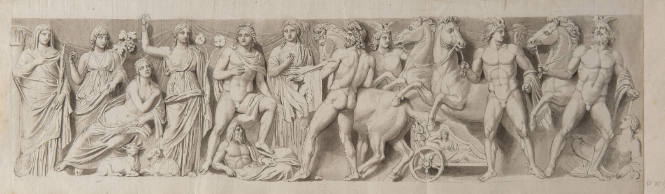
Frieze Design after a Roman Sarcophagus with Apollo, Diana, Autumn, & Summer
Portfolio/Seriesfrom a group of ten large studies of antique bas-reliefs commissioned by Edward Knight
Date1791
Artist
John Flaxman
(English, 1755-1826)
for
Edward Knight
(British, 1734 - 1812)
CultureBritish
MediumPen, ink and wash on two pieces of conjoined paper
DimensionsImage: 7 3/4 x 29 1/2 in. (19.7 x 74.9cm)
Sheet: 9 1/4 x 30 1/4 in. (23.5 x 76.8cm)
Matted: 14 3/8 x 36 1/4 in. (36.5 x 92.1cm)
Sheet: 9 1/4 x 30 1/4 in. (23.5 x 76.8cm)
Matted: 14 3/8 x 36 1/4 in. (36.5 x 92.1cm)
Credit LinePurchase, gift of Mrs. Frederick Ferris Thompson, by exchange in memory of Katharine Lee Reid, class of 1963
On View
Not on viewPeriod18th c
Classification(s)
InscribedOn verso, by artist, upper edge in ink: the horses for the chariot of the sun, the front of an Sarcophagus lately purchased by the Pope / figures about 22 inches high of a grand character of sculpture best in correct, the heads of Apollo, Diana, Autumn, & Summer as well as some of the most projecting limbs being broken are restored by me in the drawing; center: 15; on a piece of paper affixed to the right edge, by unidentified hand: U 789
BibliographyEds. Hugh Brigstocke, Eckart Marchand and A. E. Wright. John Flaxman and William Young Ottley in Italy. The Walpole Society, vol. LXXII, 2010, pp.154-155
ProvenanceCommissioned by Edward Knight (1734-1812);John Knight (1760-1850), nephew of the above;
Frederick Winn Knight (1812-1897); son of the above;
Major Eric Ayshford Knight (1863-1944), nephew of the above, at Wolverley House; Presumably sold, Wolverley House sale (G. H. Banks, Kidderminster, April 25-28 1945); Private collection to 2022
Vassar Exhibitions
Label TextCommissioned by Edward Knight, a Worcestershire ironmaster who became John Flaxman’s first major patron, this drawing reconstructs a damaged Roman sarcophagus depicting the myth of Phaethon—Helios’s son, whose reckless attempt to drive the solar chariot ended in catastrophe. Executed in pen, ink, and wash, the work exemplifies the all’antica tradition, the Renaissance practice of working “in the ancient manner.” Helios (sometimes, as here, conflated with Apollo) appears left of center, seated above the reclining, bearded Oceanus, with Clymene at his side. Phaethon himself remains conspicuously absent, though he would have stood facing his father in supplication. Four wind gods occupy the right side, harnessing steeds to the solar chariot, while seasonal allegories, Autumn and Summer among them, gain definition at left through Flaxman’s linear precision.
DescriptionA frieze-like composition of male and female figures in various states of dress with finely draped garments. The female figures at left hold flowers, grain, or grapevines while the male figures at right hold the reigns of horses. A calf and a lamb, a male figure possibly holding a snake, a chariot, and a female figure are present in the foreground.
Object information is a work in progress and may be updated as new research findings emerge.
To help improve this record, please email
loebcollections@vassar.edu
Rosalie Thorne McKenna
1951
Culture: American
Caleb Stein
2016
Culture: American