
Object number2024.33.8
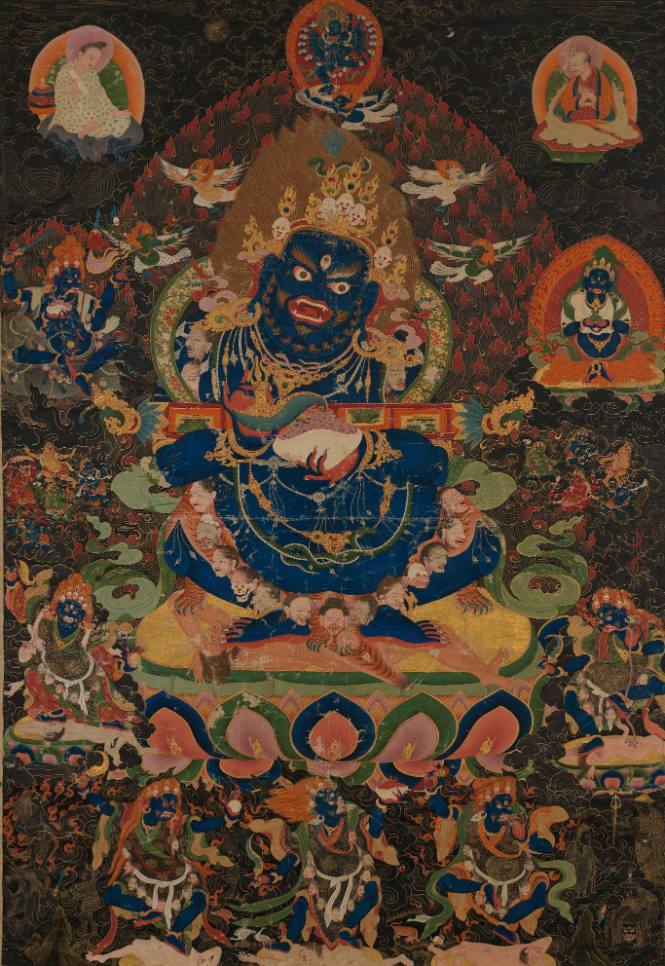
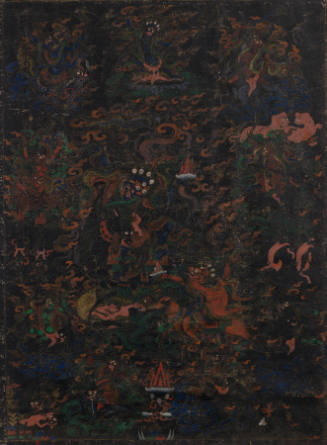
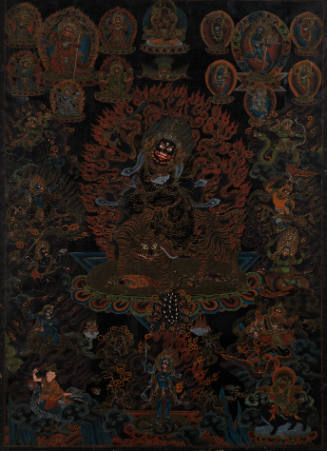
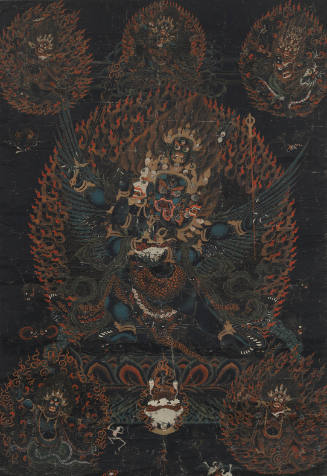
A Black Ground Thangka of Gurgi Gönpo, the Lord of the Tent
Daten.d.
Artist
Tibetan
(Tibetan, NA)
CultureTibetan
MediumDistemper on cloth
DimensionsImage: 40 1/4 x 27 1/2 in. (102.2 x 69.9 cm)
Framed: 49 1/4 x 36 5/8 x 1 3/4 in. (125.1 x 93.0 x 4.4 cm)
Framed: 49 1/4 x 36 5/8 x 1 3/4 in. (125.1 x 93.0 x 4.4 cm)
Credit LineThe Jack Shear Collection of Tibetan Art, a partnership between The Frances Lehman Loeb Art Center at Vassar College, The Tang Museum at Skidmore College, and the Williams College Museum of Art.
On View
On viewPeriod18th c
Classification(s)
Label TextWhen practitioners of Tibetan Buddhism encounter obstacles, they may rely on figures like Protector of the Tent to remove them. The wrathful appearances of the deity and his surrounding retinue are not considered demonic; rather, they embody the immense power available to destroy impediments and clear the way for spiritual progress. This destructive action is represented by the humans being trampled under the various protectors’ feet and reinforced by the billowing smoke and flames throughout the black ground composition.
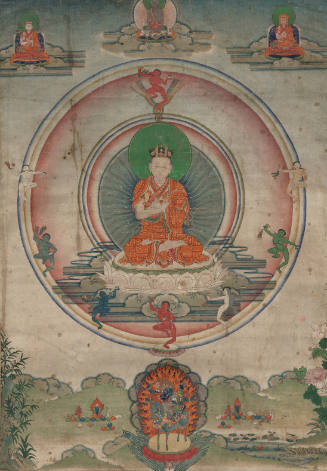
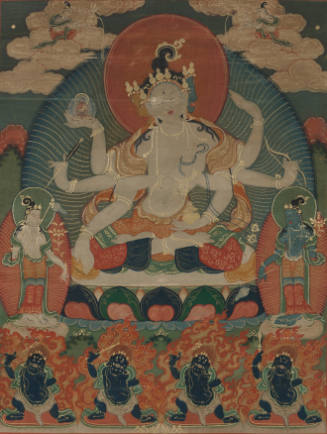
Protector of the Tent is closely associated with the Sakya, or Gray Earth, tradition of Tibetan Buddhism. Many Sakya masters were laypeople who wore special white robes such as those seen on the eminent teachers Dramzé Choksé (c. 11th century) at upper left and Sachen Künga Nyingpo (1092–1158) at upper right. Both promulgated practices associated with Protector of the Tent and the multi-armed meditational deity Kyé Dorjé at top center.
Object information is a work in progress and may be updated as new research findings emerge.
To help improve this record, please email
loebcollections@vassar.edu

Tibetan
n.d.
Culture: Eastern Tibetan
Tibetan
n.d.
Culture: Eastern Tibetan