Object number1917.1.11
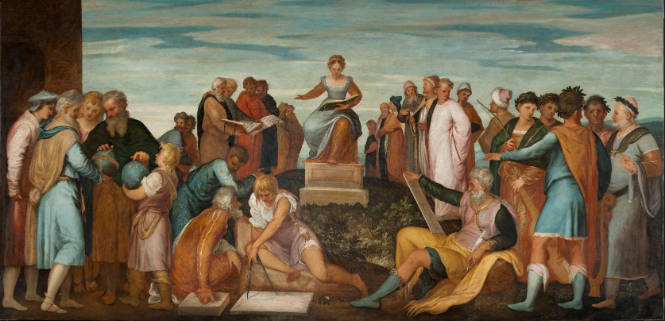
The Circle of False Education from the Tabula Cebetis
DateNd
Artist
Lambert Sustris
(Dutch, active Italy, c. 1515–after 1560)
CultureDutch, Italian
MediumOil on canvas
DimensionsUnframed: 65 1/2 x 138 1/4 in. (166.37 x 351.16 cm)
Credit LineGift of Charles M. Pratt
On View
On viewPeriod16th c
Classification(s)
Label TextThe Tabula Cebetis or Tablet of Cebes is a philosophical work written by a pseudonymous author of the first or second century under the name of Cebes, one of Socrates’ inner circle.
The work professes to be an interpretation of an allegorical painting in which the whole of human life with its dangers and temptations was symbolically represented. In the story, some youths are trying to understand the painting and an elder comes and explains its meaning. It is intended to show that only the proper development of our mind and the possession of real virtues can make us truly happy.
There are multiple circles painted on the tablet. One– the scene depicted here– is The Circle of False Education. This is something of a misnomer. The education portrayed is real– basically the traditional seven Liberal Arts. It is conventional education. The elder explains that this is not a destination in itself but a stop on the way to “true” education. The other component is moral education. You need education but no amount will itself make you a good person. You also need values.
The painting is part of a cycle of five canvas murals originally destined for a Venetian palace. The other depict the Circle of Fortune, The Circle of Deception, The Circle of True Education and Happiness and The Way to True Education. The large paintings were executed by the Dutch artist Lambert Sustris who spent most of his career in Italy and was part of Titian’s workshop.
Terms
Object information is a work in progress and may be updated as new research findings emerge.
To help improve this record, please email
loebcollections@vassar.edu