Object number2014.20.1
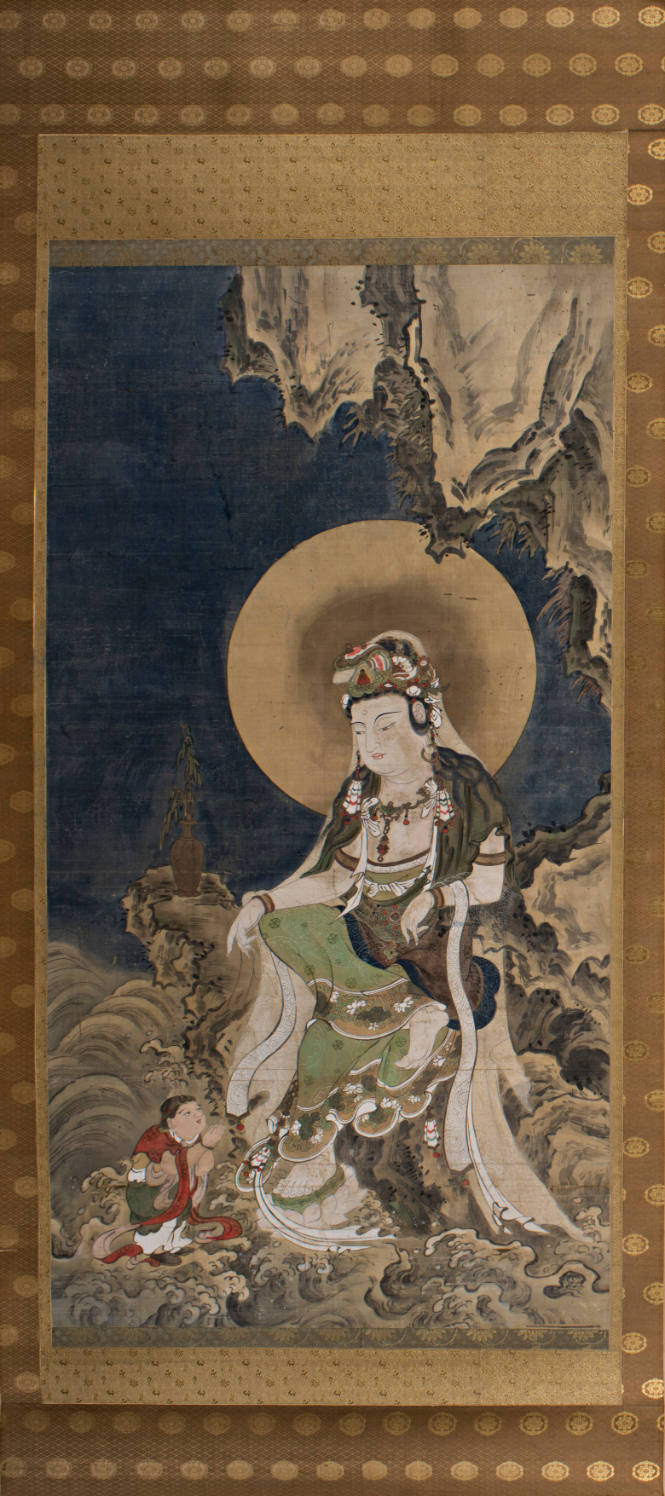
Avalokiteshvara
Artist
Japanese
(Japanese, NA)
CultureJapanese
MediumInk and color on silk
DimensionsFramed: 88 1/8 × 39 7/8 × 2 1/4 in. (223.8 × 101.3 × 5.7 cm)
Mount: 87 7/8 × 39 1/2 in. (223.2 × 100.3 cm)
Image: 61 7/8 × 33 in. (157.2 × 83.8 cm)
Mount: 87 7/8 × 39 1/2 in. (223.2 × 100.3 cm)
Image: 61 7/8 × 33 in. (157.2 × 83.8 cm)
Credit LineGift of Daniele Selby, class of 2013
On View
Not on viewPeriod18th / 19th c
Classification(s)
Vassar Exhibitions
Exhibition HistoryEmbodying Compassion in Buddhist Art: Image, Pilgrimage, Practice, Frances Lehman Loeb Art Center, Vassar College, Poughkeepsie, NY, April 23 - June 28, 2015Label TextKnown in Japan as Kannon Bosatsu, the bodhisattva Avalokiteshvara is the Buddhist embodiment of unceasing compassion and benevolence. Often shown with a vase filled with elixir that is provided to suffering beings, here, the vessel also holds a willow branch, which represents healing. While early Indian texts clearly define Avalokiteshvara as male, as Buddhism developed in East and Southeast Asia, many cultures came to identify Kannon as female. Surrounded by a large moon that doubles as a halo, Kannon sits in a seaside cave in the company of Zenzai Doji, a young boy who traveled to Kannon's paradise realm Fudaraka in order to understand the bodhisattva path.
Terms
Object information is a work in progress and may be updated as new research findings emerge.
To help improve this record, please email
loebcollections@vassar.edu


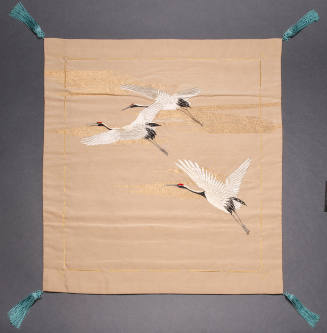
Japanese (Kyoto)
1868-1912
Culture: Japanese