Object number1880.2
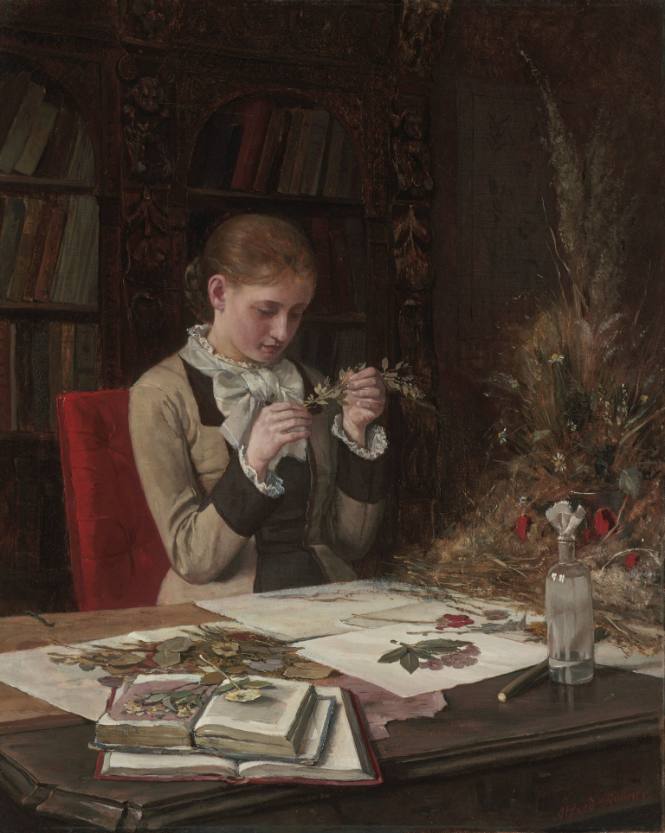
The Botanist
Datec. 1875
Artist
Alfred Ronner
(Belgian, 1852-1901)
CultureBelgian
MediumOil on canvas
DimensionsUnframed: 23 5/8 x 19 1/8 in. (60.01 x 48.58 cm)
Credit LineGift of Rezin A. Wight
Period19th c
Classification(s)
SignedSigned (LR): Alfred Ronner
InscribedInscribed (verso): Painted for Albert D'Huyyetter, Jr., Antwerp and Brooklyn, according to a label on the reverse). Note (2/16/15): label on verson no longer visible
BibliographyUniversal Collection: A Mark Dion Project (Poughkeepsie: FLLAC, 2016), p. 43 repr.;
Malstrom, Amanda. The Art of Emily Cole. Catskill, New York: Thomas Cole National Historic Site, 2024. p. 23.
Mundy, James, The Frances Lehman Loeb Art Center: Vassar College The History and Collection (New York: Prestel Publishing, 2007), p. 92 repr.;
Modeling Femininity: Art and the Moral Education of Nineteenth-Century Women (Poughkeepsie: FLLAC), p. 2;
Malmstorm, Amanda. “‘Catskill China Painter’ The Art of Emily Cole,” in The Art of Emily Cole, Catskill, NY: Thomas Cole National Historic Site, 2024, p. 23Vassar Exhibitions
Exhibition HistoryPoughkeepsie, New York, FLLAC, Vassar College, "Universal Collection: A Mark Dion Project," May 26, 2016-December 11, 2016; Poughkeepsie, New York, FLLAC, Vassar College, "Modeling Femininity: Art and the Moral Education of Nineteenth-Century Women," January 27-March 15, 2000;
Poughkeepsie, New York, Vassar College Art Gallery, "Nineteenth Century -- A Panorama of Taste", September 1945.
Label TextThe Botanist depicts a young woman engaged in the solitary and detailed study of botanical specimens. During the eighteenth and nineteenth centuries, upper- and middleclass European women had a strong presence in the field of botany. Though women were often excluded from institutional spheres, the domestic context was considered suitable for women to practice science. Botany and plants were associated with common attributes of femininity and domesticity, such as caretaking, delicacy, and aesthetic or decorative value. The young woman in Ronner’s painting is not handling exotic plants, but rather what appear to be local wildflowers and grasses, including daisies and poppies, likely collected not far from her home. Botanists use illustrated fieldguides, like the one depicted at lower left, which contain illustrations and key information to aid in plant identification. Botanical practice involved collecting, preserving, identifying, and illustrating specimens. Ronner alludes to the rigor of this practice by showing the woman’s careful inspection in a study filled with books and including what appears to be a Linnaean botanical chart, a visual tool used for plant identification, in the upper right corner. This painting entered the collection of the Loeb (then the Vassar College Art Gallery) in 1880, less than twenty years after the founding of Vassar as a women’s college, and remains an invaluable depiction of the contributions of women to the sciences.
Object information is a work in progress and may be updated as new research findings emerge.
To help improve this record, please email
loebcollections@vassar.edu