Object number2008.27.16
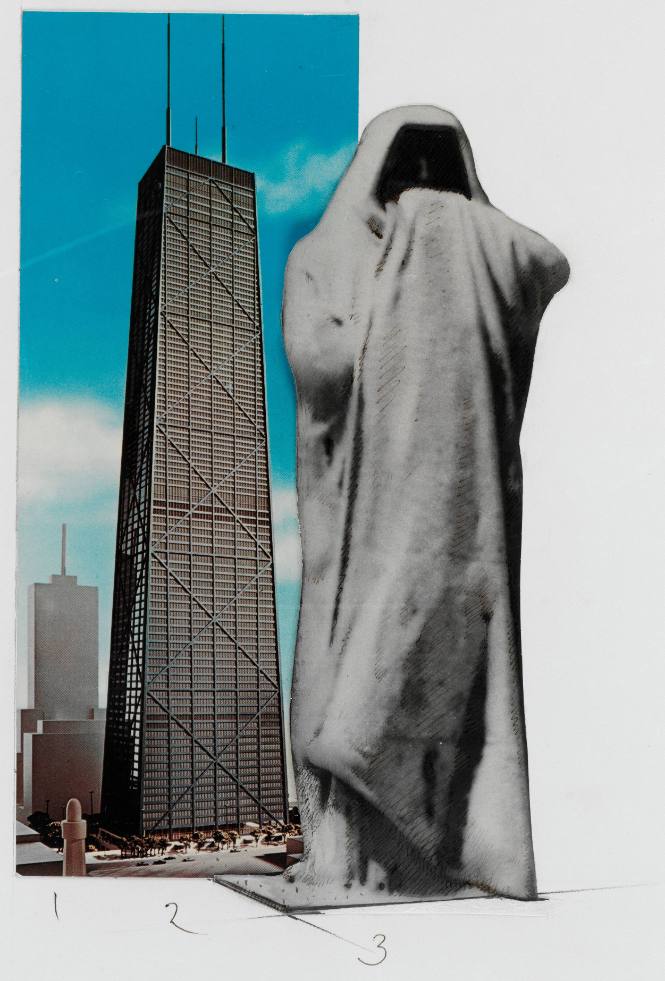
Proposal for a Skyscraper for Michigan Avenue, Chicago in the form of Lorado Taft’s sculpture “Death”
Date1968
Artist
Claes Oldenburg
(American, 1929 - 2022)
CultureAmerican
MediumCollage, ink, and graphite on cream wove paper
DimensionsSheet: 11 3/4 x 9 3/4 in. (29.85 x 24.77 cm)
Framed: 14 1/4 x 11 x 1 1/2 in. (36.2 x 27.94 x 3.81 cm)
Framed: 14 1/4 x 11 x 1 1/2 in. (36.2 x 27.94 x 3.81 cm)
Credit LineGift of Leon Despres in memory of Marian Alschuler Despres, class of 1930
On View
Not on viewPeriod20th c
Classification(s)
SignedSigned and dated (LRC, in ink): CO 68
InscribedInscibed (verso): (Richard Feigen Gallery label) Claes Oldenburg: Proposal for a skyscraper for Michigan Avenue, Chicago in the form of Lorado Taft's sculpture "Death"", collage & drawing, 1968, 11 3/4" x 9 3/4", #3967-B; (Pasadena Art Museum label) CAT.147 CR.52, Loan No. 205.71, Medium: Collage and drawing, Artist: Claes Oldenburg, Size: 11 3/4 x 9 3/4", Title: PROPOSAL FOR A SKYSCRAPER FOR MICHIGAN AVENUE, CHICAGO IN THE FORM OF LORADO TAFT'S SCULPTURE "DEATH" 1968, Lender: Mr. and Mrs. Leon Despres., Exhibition: CLAES OLDENBURG-OBJECT INTO MONUMENT Dec. 7, 1971-Feb. 6, 1972
BibliographyMichael Darling, Joanna Szupinska, "Skyscraper Art and Architecture Against Gravity," Museum of Contemporary Art Chicago Bulletin, Page 18. Exhibition HistoryChicago, Illinois, Museum of Contemporary Art Chicago, "Skyscraper Art and Architecture Against Gravity," 21 May - 2 November, 2012. Cat. p. 18, repr.Label TextClaes Oldenburg, who grew up in Chicago in the 1930s and 40s, witnessed the construction of the city’s John Hancock Center, a 100-story skyscraper completed in 1969, with mixed emotions. The building, as the artist describes it, is “machine-made” – that is, it is not the actualization of an architect’s vision, but rather a practical solution to ensure the the structure provides sufficient space. He said:
“While I like the Hancock, I feel resentful of its scale – it follows you around and has obliterated the building I grew up by and knew as The Skyscraper: the former Palmolive, now Playboy, whose proud beam now strikes somewhere around its big neighbor’s waist.”
Oldenburg speculated that his intention with this proposal may have been to “do to the Hancock building what it has done to the Playboy building.” The striking silhouette of the Playboy Building, a high-rise completed in the 1920s, was eclipsed by the new structure. In 1968, when visiting Chicago’s Graceland Cemetery, Oldenburg saw Lorado Taft’s sculpture Death, which is set in front of a large black slab. In the collage, the Hancock building stands in place of this slab and is overshadowed by the colossal Death-shaped structure. By juxtaposing the enlarged sculpture Death, the Hancock skyscraper, and the Playboy building, as well as their respective romantic and modern associations, Oldenburg creates a representation of Chicago history, Midwest nostalgia, and the greater passage of time.
Object information is a work in progress and may be updated as new research findings emerge.
To help improve this record, please email
loebcollections@vassar.edu
Claes Oldenburg
1967
Culture: American
Charles Percier
Nd
Culture: French