Object number1999.31
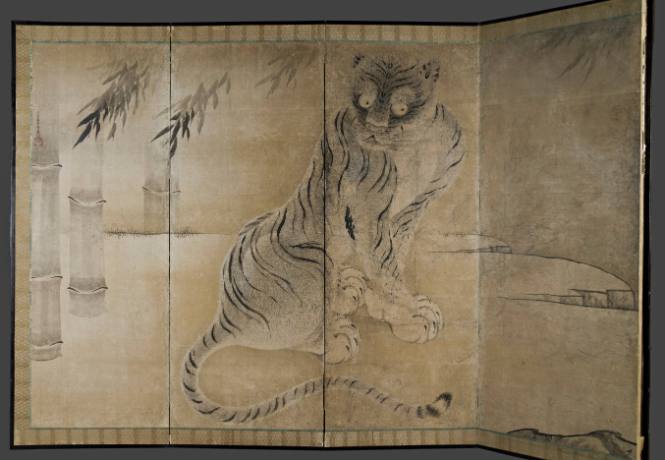
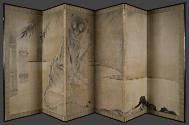
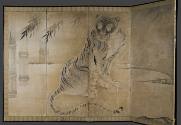
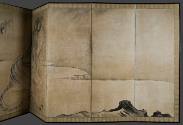
Six-Fold Screen with Tiger
Daten.d.
Artist
Unkoku Toeki
(Japanese, 1591-1644)
CultureJapanese
MediumBrush and ink on paper mounted on silk brocade
Dimensionseach panel: 59 13/16 x 21 5/8 in., (151.9 x 54.9 cm,)
overall: 66 1/8 x 138 9/16 in. (168 x 352 cm)
overall: 66 1/8 x 138 9/16 in. (168 x 352 cm)
Credit LineGift of Joan and Robert Bernhard (Joan E. Mack, class of 1953)
Period17th c
Classification(s)
SignedSigned (on bamboo, UL, at edge): Unkoku Hokkyo Toeki; (two seals of artist, one of double gourd shape
BibliographyRefining the Imagination: Tradition, Collecting and the Vassar Education (Poughkeepsie: FLLAC, 1999), p. 145 repr. Vassar Exhibitions
Exhibition History"Refining the Imagination: Tradition, Collecting and the Vassar Education" Frances Lehman Loeb Art Center, 23 April -19 September 1999.Poughkeepsie, New York, The Frances Lehman Loeb Art Center, Vassar College, "A Museum Menagerie: Highlights from the Permanent Collection," April 25 - August 13, 2017
Label TextThis six-panel screen displays a large tiger at the edge of a bamboo grove, turning to gaze fiercely at the viewer with its enormous eyes. In East Asia, there existed a long tradition of artists depicting tigers with dragons to signify the yin and yang balance of spiritual powers, but this scene shows the creature perched alone near a cliff. In this period, the tiger alone often symbolized secular power, making it a popular subject among warriors. Toeki, patronized by powerful daimyos, created such decorative screens for warrior-rulers. In this work, a thin, black line denotes the edge of the land, while bold ink washes indicate bamboo stalks and leaves. The tiger is painted in sharper details, with individual stripes and hairs delicately rendered from light to dark. Controlled line and tone capture both the fluid shape and the texture of the creature, bringing it fully to life. This style of painting reflects the influence of Sesshu Toyo (1420–1506), the revered master of Japanese ink painting. Seungmin Yoo '19
Object information is a work in progress and may be updated as new research findings emerge.
To help improve this record, please email
loebcollections@vassar.edu
Nakahara Nantenbo
c. 1918
Culture: Japanese
Nakahara Nantenbo
c. 1918
Culture: Japanese