
Object number1991.35.3
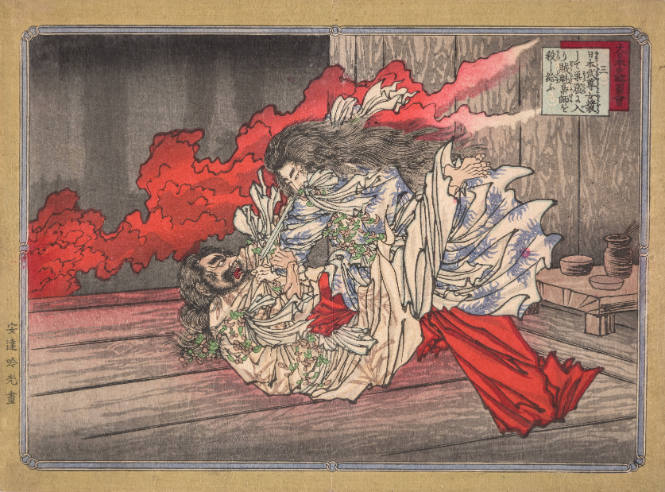
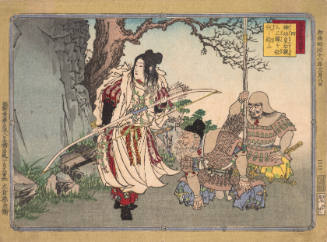
Number 3: Prince Yamato Takeru Wears Women’s Clothes to Enter a Secret Lair and Bring Death to Rebel Leader Takeru
Portfolio/Seriesfrom the series Illustrated History of Great Japan
Date1885
Artist
Adachi Ginkō(安達 吟光)
(Japanese, 1853 - 1902)
Publisher
Ōkura Magobei (大倉孫兵衛)
(Japanese)
CultureJapanese
MediumWoodblock print (nishiki-e); ink and color on paper
DimensionsImage: 6 5/16 x 8 11/16 in. (16 x 22 cm)
Sheet (Horizontal chūban): 7 1/16 x 9 7/16 in. (18 x 24 cm)
Sheet (Horizontal chūban): 7 1/16 x 9 7/16 in. (18 x 24 cm)
Credit LineGift of Justine Lewis Keidel, class of 1937
Period19th c (Meiji period)
Classification(s)
SignedOn recto, signed lower left center in margin in black ink printed in block: 安達吟光畫
Transliteration (Translation): Adachi Ginkō kaku (Illustrated by Adachi Ginkō)
InscribedOn recto, series title in upper right corner, in red cartouche, printed in block: 大日本史略図会 (Dai Nihon shiryaku zue (Illustrated History of Great Japan)
On recto, print title in upper right corner, in yellow cartouche, printed in block: 三 日本武尊女装してて巣窟に入り賊魁梟師を殺し給ふ (San: Yamato Takeru no Mikoto nyosō shite sōkutsu ni iri zokukai Takeru o koroshitamau (Number 3: Prince Yamato Takeru Wears Women’s Clothes to Enter a Secret Lair and Bring Death to Rebel Leader Takeru)
Label TextDrawn from a subplot in the Kojiki, an eighth-century chronicle of early Japanese myths, legends, and history, this print depicts the episode in which the legendary hero Yamato Takeru receives his name. In the original story, we are introduced to the protagonist as Prince Ōsu. His father, Emperor Keikō, is shocked when Prince Ōsu kills his own brother, so he sends him westward to use his brute strength to subdue the Kumaso. After discovering and infiltrating a banquet held by his enemies, Prince Ōsu fatally stabs one of the rebel leaders, Kawakami Takeru, in the chest. Commending him on his strength and cunning, the dying chieftain bestows upon the prince the name Yamato Takeru, meaning “The Brave of Yamato.”
In the illustration, we see the moment that Prince Ōsu strikes Kawakami. Both figures wear jewelry adorned with magatama (curved, comma-shaped beads), visually indicating that both figures are of important ranks. The red worn by Prince Ōsu represents the skirt of his aunt, which he uses as part of his disguise. Scholar C. Scott Littleton has described the narrative arch of Yamato Takeru as “Arthurian,” pointing to structural similarities between the two legends and proposing they share a common Iranian ancestor. However, concrete evidence that such a story traveled from Central Asia to Japan remains lacking.
Christopher Moody, class of 2026
Object information is a work in progress and may be updated as new research findings emerge.
To help improve this record, please email
loebcollections@vassar.edu
Adachi Ginkō(安達 吟光)
1885
Culture: Japanese
Adachi Ginkō(安達 吟光)
1885
Culture: Japanese
Adachi Ginkō(安達 吟光)
1885
Culture: Japanese
![[Number] 36](/internal/media/dispatcher/58726/thumbnail)
![[Number] 5](/internal/media/dispatcher/58722/thumbnail)
Adachi Ginkō(安達 吟光)
1885
Culture: Japanese
![[Number] 21](/internal/media/dispatcher/58740/thumbnail)
Adachi Ginkō(安達 吟光)
1885
Culture: Japanese
![[Number] 18](/internal/media/dispatcher/58731/thumbnail)
![[Number] 11](/internal/media/dispatcher/58728/thumbnail)
![[Number] 25](/internal/media/dispatcher/58744/thumbnail)
![[Number] 26](/internal/media/dispatcher/58729/thumbnail)