Object number1987.20.17
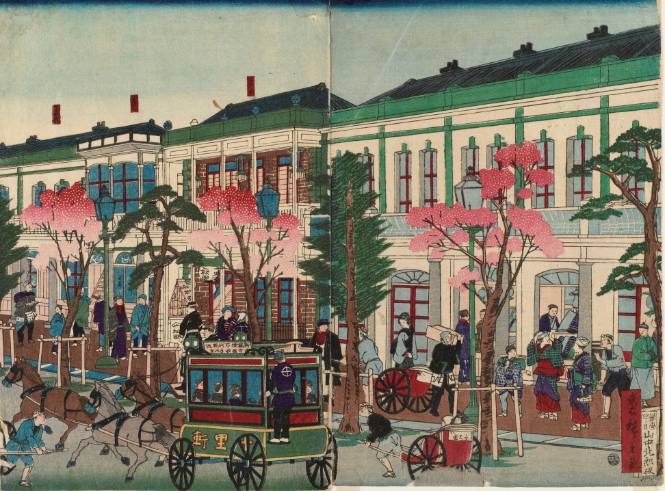
View of Ginza Kyobashi Stone Gas Lamps
Portfolio/Seriesfrom the series Famous Views of Tokyo
Date1880
Publisher
Yamanaka Kitarō
(Japanese)
CultureJapanese
MediumWoodblock print (nishiki-e); ink and color on paper
DimensionsSheet: 14 3/16 x 9 3/4 in. (36 x 24.8 cm)
Overall: 14 3/16 x 19 1/4 in. (36 x 48.9 cm)
Matted: 21 3/4 x 28 in. (55.2 x 71.1 cm)
Framed: 22 5/8 x 28 3/4 x 1 1/16 in. (57.5 x 73 x 2.7 cm)
Overall: 14 3/16 x 19 1/4 in. (36 x 48.9 cm)
Matted: 21 3/4 x 28 in. (55.2 x 71.1 cm)
Framed: 22 5/8 x 28 3/4 x 1 1/16 in. (57.5 x 73 x 2.7 cm)
Credit LineGift of Justine Lewis Keidel, class of 1937
Period19th c (Meiji period)
Classification(s)
SignedOn recto, lower right, in red cartouche, artist's signature in block: 歌川 広重 [三代目 ] (Utagawa Hiroshige [III])
InscribedOn recto, lower right, in yellow cartouche, publisher's signature and address in block: 銀座四丁目山中北郎板 (Ginza yon-chōme Yamanaka Kitarō han/ Published by Yamanaka Kitarō [at address:] Ginza 4-chōme)
BibliographyCenturies of Change: 18th to 20th Century Prints, Selections from the Permanent Collection, (Poughkeepsie: FLLAC, 1989) Vassar Exhibitions
Exhibition HistoryPoughkeepsie, NY, FLLAC, Vassar College, "Centuries of Change: 18th to 20th Century Japanese Prints, Selections from the Permanent Collection," March 20 - May 8, 1989Cooperstown, New York, Fenimore Art Museum, "Madame Butterfly's World: Woodblock Prints of a Changing Japan," June 21 - September 21, 2014
Label TextIn 1872, a major fire destroyed 34 towns and 2,926 houses stretching from today’s Otemachi to Ginza Kyobashi districts in Tokyo. In its wake, the Meiji government led an initiative to make Tokyo a fire-resistant city. Ginza Bricktown was erected in the location destroyed by the 1872 fire, becoming a model site for the efforts. In View of Ginza Kyobashi Stone Gas Lamps, Utagawa Hiroshige III shows a civilization thriving under the influence of Westernization. The district’s main street, Ginza-dōri, is designed as a Western-style cityscape outfitted with brick buildings meant to resist flame. Carefully regulated city planning and attention to the latest technological innovations are reflected in the gas stone lanterns, standardized building heights relative to road widths, and orderly tree plantings. To achieve rapid modernization and Westernization, Japan hired foreign experts to complete the work. In reality, the buildings in Ginza Bricktown were architecturally ill-suited for Japan’s humid climate. Many buildings were vacant, and it took several years for the quarter to attract residents and businesses.
Object information is a work in progress and may be updated as new research findings emerge.
To help improve this record, please email
loebcollections@vassar.edu
Utagawa Hiroshige (歌川 広重)
c. 1847-1852
Culture: Japanese
Utagawa Hiroshige (歌川 広重)
c. 1845
Culture: Japanese
Margaret Bourke-White
1953
Culture: American
Utagawa Hiroshige (歌川 広重)
c. 1832-1838
Culture: Japanese