Object number1987.20.44.c
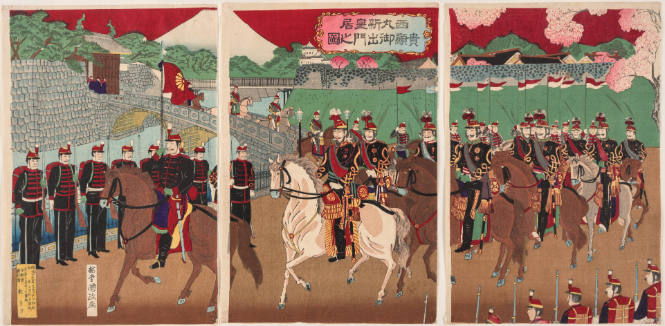
Illustration of Nobility Departing from the Gate in Front of the Nishimaru Building of the New Imperial Palace
Date1888
Artist
Utagawa Kunisada, III
(Japanese, 1844-1920)
CultureJapanese
MediumWoodblock print (nishiki-e); ink and color on paper
DimensionsSheet: 14 3/8 x 9 5/8 in. (36.51 x 24.45 cm)
Credit LineGift of Justine Lewis Keidel, class of 1937
Period19th c (Meiji period)
Classification(s)
Label TextUtagawa Kunisada III depicts the emperor mounted on a white horse and dressed in a Western-style uniform, leading a show of military might. In the middle ground are the Imperial Palace, built on the ruins of the Tokugawa shogunate’s Edo Castle, which burned in 1873, and the Nijūbashi Bridge. The iron bridge was built in 1888—the same year this print was published—to replace the shogunate’s wooden bridge. The iconography of the palace, bridge, and imperial procession, joined with Mount Fuji in the background, marries the new government with history in a single image.
As an iconic symbol of Japanese culture, Mount Fuji had been used in the past to express stability and fortitude of the Tokugawa shogunate, as in Hiroshige’s prints. By placing the Imperial Palace together with Mount Fuji, Kunisada III positioned the future of the new Meiji government within the same visual language of government stability. Signs of the country’s modernization, including the iron bridge and the noblemen’s Western-style military uniforms, communicate that while the Meiji government was part of the greater Japanese historical narrative, it also looked toward progress. The Meiji government sought to promote the nation’s self-image and situate it as a global power through four prominent slogans: bunmei kaika (civilization and enlightenment), fukoku kyōhei (enrich the country, strengthen the military), wakon yōsai (Japanese spirit, Western skill), and datsu-a nyū-ō (leave Asia, join Europe). These phrases informed the foundation of Meiji Japan and served to instill among its people ideologies that were circulated in visual media and literature.
Object information is a work in progress and may be updated as new research findings emerge.
To help improve this record, please email
loebcollections@vassar.edu
Utagawa Kunisada, III
1888
Culture: Japanese
Utagawa Kunisada, III
1888
Culture: Japanese
Utagawa Kunisada, III
1888
Culture: Japanese
Utagawa Hiroshige, III
1881
Culture: Japanese

Utagawa Kunisada I (Toyokuni III)
1815
Culture: Japanese