Object number1987.21.8
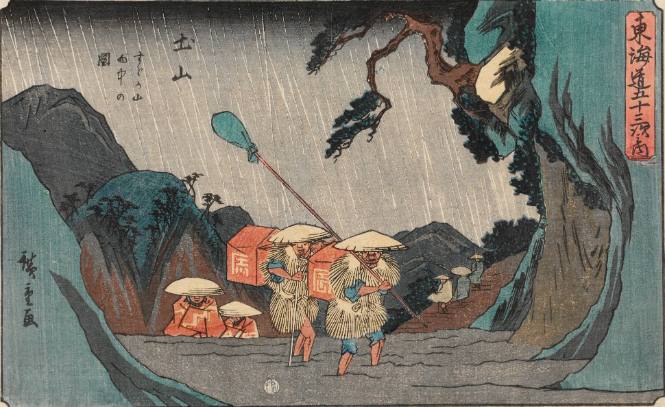
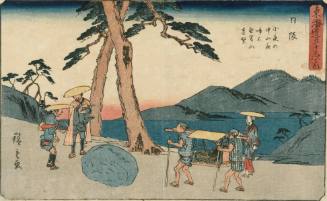
Tsuchiyama: The Suzuka Mountains in the Rain
Portfolio/Seriesfrom the series Fifty-three Stations of the Tokaido Road (Gyosho Tokaido)
Dateca. 1845
Artist
Utagawa Hiroshige (歌川 広重)
(Japanese, 1797-1858)
CultureJapanese
MediumWoodblock print (nishiki-e): ink and color on paper
DimensionsImage: 7 11/16 x 12 1/2 in. (19.5 x 31.7 cm)
Sheet (Horizontal aiban): 9 x 13 3/16 in. (22.9 x 33.5 cm)
Sheet (Horizontal aiban): 9 x 13 3/16 in. (22.9 x 33.5 cm)
Credit LineGift of Celia Faulkner Clevenger, class of 1958
Period19th c (Edo Period)
Classification(s)
SignedOn recto, signed lower left edge, in block: 広重画 (Hiroshige ga)
InscribedOn recto, upper right, in block: 東海道五十三次の内 (Fifty-three Stations of the Tokaido Road)
On recto, top left edge, in block: 土山 すずく山雪中之図 (Tsuchiyama: The Suzuka Mountains in the Rain)
Vassar Exhibitions
Label TextA daimyo procession is shown making the arduous journey along the Tōkaidō through a heavy downpour. Traveling in large processions along the Tōkaidō was a costly exercise for the feudal lords and a public display of their fealty to the shogunate. During a period of peace, they also served as visible symbols of status and authority, with multifaceted displays of power. For example, the number of lances or spears at the front or rear of a procession denoted the daimyo’s level of importance, with fewer spears indicating a lesser degree of distinction. In this print, the presentation of status symbols is ambiguous. A single implement with its tip wrapped in blue cloth at the beginning of the procession would seem to connote a lesser lord. However, the privilege of transporting hasamibako, lacquer chests that bore the family crest, was only permitted for select daimyo. The object wrapped in red cloth, carried by the two foreground figures, may be a hasamibako, indicating high status.
Object information is a work in progress and may be updated as new research findings emerge.
To help improve this record, please email
loebcollections@vassar.edu



Utagawa Hiroshige (歌川 広重)
c. 1845
Culture: Japanese