Object number1984.55.6
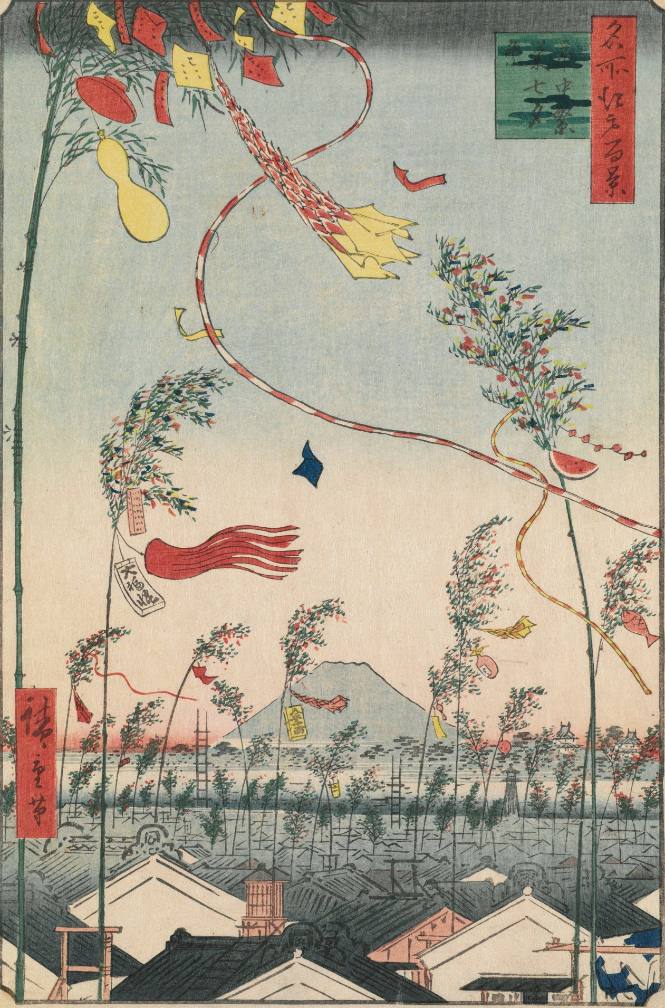
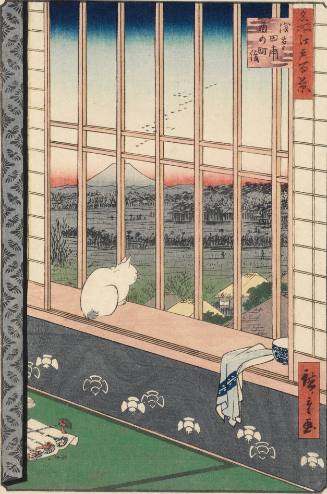
The City Flourishing, Tanabata Festival
Portfolio/Seriesfrom the series One Hundred Famous Views of Edo
Date1857
Artist
Utagawa Hiroshige (歌川 広重)
(Japanese, 1797-1858)
Publisher
Uoya Eikichi
CultureJapanese
MediumWoodblock print (nishiki-e); ink and color on paper
DimensionsImage: 13 5/16 x 8 7/8 in. (33.8 x 22.5 cm)
Sheet (Vertical ōban): 14 1/8 x 9 7/16 in. (35.8 x 24 cm)
Sheet (Vertical ōban): 14 1/8 x 9 7/16 in. (35.8 x 24 cm)
Credit LineGift of Elizabeth Coonley Faulkner, class of 1924
Period19th c (Edo Period)
Classification(s)
SignedOn recto, signed lower left in block: 広重筆 (Hiroshige hitsu)
InscribedOn recto, upper right in block:「名所江戸百景」One Hundred Famous Views of Edo (Meisho Edo hyakkei) 「市中繁栄七夕祭」The City Flourishing, Tanabata Festival (Shichū hanei Tanabata Matsuri)
MarkingsOn recto, upper right, censor's seal in block: 改、巳七 (aratame, Snake 7)
On recto, lower left, publisher's seal partially trimmed, in block: 魚栄 (Uoei)
Vassar Exhibitions
Label TextUtagawa Hiroshige’s The City Flourishing, Tanabata Festival portrays the capital of Edo as powerful, peaceful, and thriving under the Tokugawa shogunate. The work was printed in the middle of the Bakumatsu (1853–1867), the transitional period from the Tokugawa shogunate to the Meiji government. The shogunate faced foreign and domestic pressure, as seen in View of Russian Procession Ashore Playing Music (seen on the far right), which resulted in anxieties of its citizens on display in On the Belly of Courage, the Hand of Anxiety (at center). In contrast to the trepidation that characterizes those works, here Hiroshige focuses on the summertime celebration of the Tanabata Festival, which marks the reunion of two star-crossed lovers from legend. In the print, strips of wishes written during the festival by merrymakers sway in the wind. An emblem of endurance, Mount Fuji is prominently featured in the lower center of the composition, situated as if it were the recipient of those desires. Positioned to the right of the mountain is Edo Castle, the residence of the Tokugawa shogunate and a symbol of strength.
Object information is a work in progress and may be updated as new research findings emerge.
To help improve this record, please email
loebcollections@vassar.edu


Utagawa Hiroshige (歌川 広重)
c. 1832-1838
Culture: Japanese