Object number1989.19.1
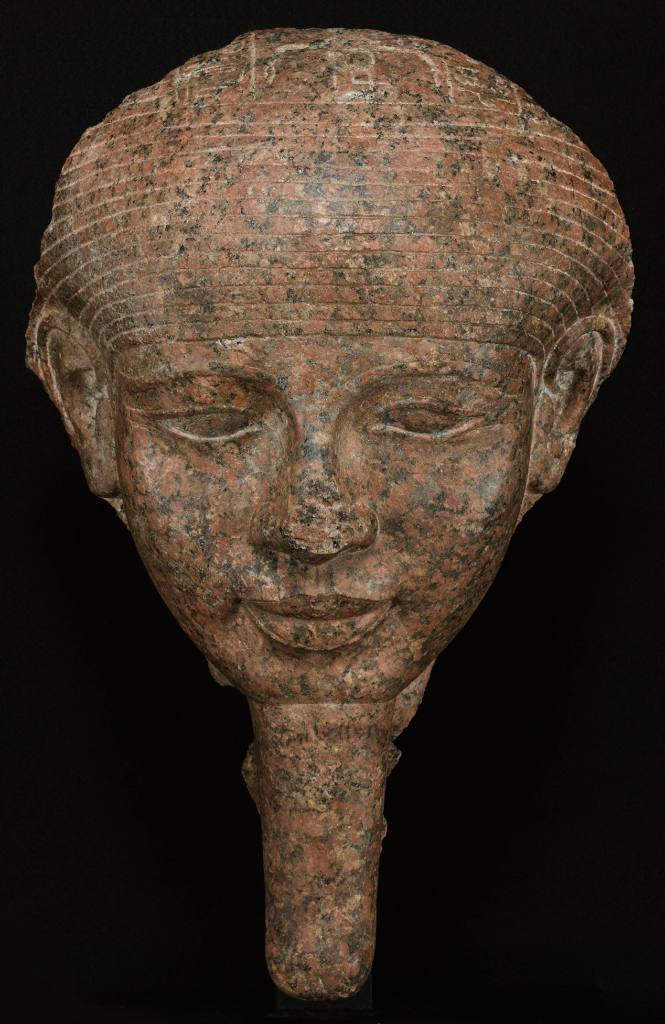
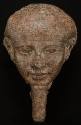
Head of Viceroy Merymose from his Outer Sarcophagus
Datec. 1375 BCE
Artist
Egyptian
(Egyptian, NA)
CultureEgyptian
MediumRed granite
DimensionsOverall: 27 9/16 × 17 3/4 × 8 3/4 in. (70 × 45.1 × 22.2 cm)
Credit LineGift of Margaret Lanphier Wengren, class of 1938
On View
On viewPeriod18th Dynasty
Classification(s)
*Other fragments of Merymose 's sarcophagus are in the Louvre, British Museum and Boston Museum of Fine Arts.
Exhibition HistoryEgypt’s Dazzling Sun Amenhotep III and His World, The Cleveland Museum of Art, July 1 - September 27, 1992; Kimbell Art Museum, Fort Worth, October 24, 1992 - January 31, 1993; Galeries Nationales du Grand Palais Paris, March 2 - May 31, 1993;
Highlights from the Vassar College Collection, IBM Gallery of Science and Art, New York, NY, July 13 - Sept. 11, 1993
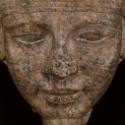
Label TextThis large sculpted head was cut from a massive outer sarcophagus constructed for Merymose, a powerful and wealthy viceroy who served under Amenhotep III. Merymose controlled a large territory that included Nubia and Kush, whose extensive gold mines supplied Egypt’s treasury. The viceroy’s importance is evident in the construction of his sarcophagi, portions of which are at other museums. The outer coffin, of which this head is a part, is made of red granite and contained two granodiorite coffins within. All three were carved in raised relief.
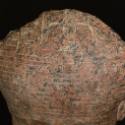
Like members of the Egyptian royal family, Merymose appears as a deity. His refined facial features, striped wig, and false beard all link Merymose with Osiris, the ancient Egyptian god of the dead and the afterlife. On top of the headpiece a carved inscription depicts the goddess Nephthys. Of her several qualities, this protective goddess served a funerary role when she helped her sister Isis gather the remains of Osiris, after his brother had dismembered him. The image of Nephthys is accompanied by the text, “Words spoken: ‘I have surrounded this (my brother, the Osiris Merymose, your limbs) shall not be weary.'”
Object information is a work in progress and may be updated as new research findings emerge.
To help improve this record, please email
loebcollections@vassar.edu