![[Untitled]](/internal/media/dispatcher/4294/preview)
Object number1941.3
[Untitled]
Portfolio/Seriesfor the book Hélène chez Archimède
Datec. 1927
engraver
Georges Aubert
(French, 1886 - 1961)
after
Pablo Picasso
(Spanish, 1881-1973)
Author
André Suarès
(French, 1868 - 1948)
CultureSpanish
MediumWood engraving
DimensionsImage: 10 13/16 x 8 1/8 in. (27.5 x 20.7 cm)
Sheet: 12 3/16 x 9 5/16 in. (31 x 23.6 cm)
Sheet: 12 3/16 x 9 5/16 in. (31 x 23.6 cm)
Credit LineGift of Mrs. J. Russell Lynes (Mildred Akin, class of 1932)
On View
Not on viewPeriod20th c
Classification(s)
InscribedOn verso, by unidentified hand, upper center in pencil: Bois de Picasso / Gravé par Aubert / Mme Helène chez Archimède / d'André Suarès / (Vollard)
Copyright© Estate of Pablo Picasso / Artists Rights Society (ARS), New York
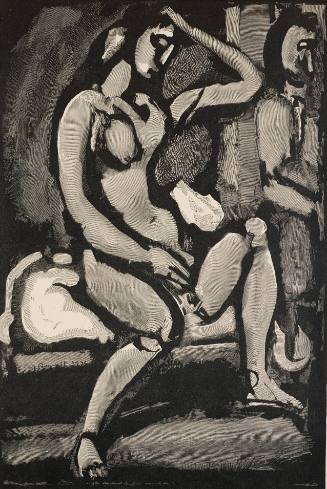
Label TextThis dramatic print by Pablo Picasso features two female figures standing in close proximity to one another. Both rendered with swirling lines and shapes, their bodies fluidly meld together. It is unclear where one woman’s body ends and the other begins. The identities of the figures are equally ambiguous: The viewer is compelled to wonder whether one of the women is the real-life model and the other is her sculpted image. The women’s faces are fragmented into both profile and frontal views, which further generates a sense of mystery surrounding their identities. Placed within an abstract and undefined space, the two figures seem to muse upon each other. One must wonder if this print depicts Marie-Thérèse Walter, one of Picasso’s many mistresses. Picasso began his affair with Walter in 1927, when he was forty-five years old and she was just seventeen. This context from Picasso’s personal life offers a more nuanced insight into the story behind this work, and challenges us to not simply view it as an example of Picasso’s virtuosity.
DescriptionBlack and (now) beige depiction of two female forms rendered in simplified and abstracted shapes, as is characteristic of the Cubist style. One figure looks out towards the viewer and the other faces away, both with their bodies turned towards the viewer. Abstract lines and shapes fill the black background.
Object information is a work in progress and may be updated as new research findings emerge.
To help improve this record, please email
loebcollections@vassar.edu