Object number1987.56.2
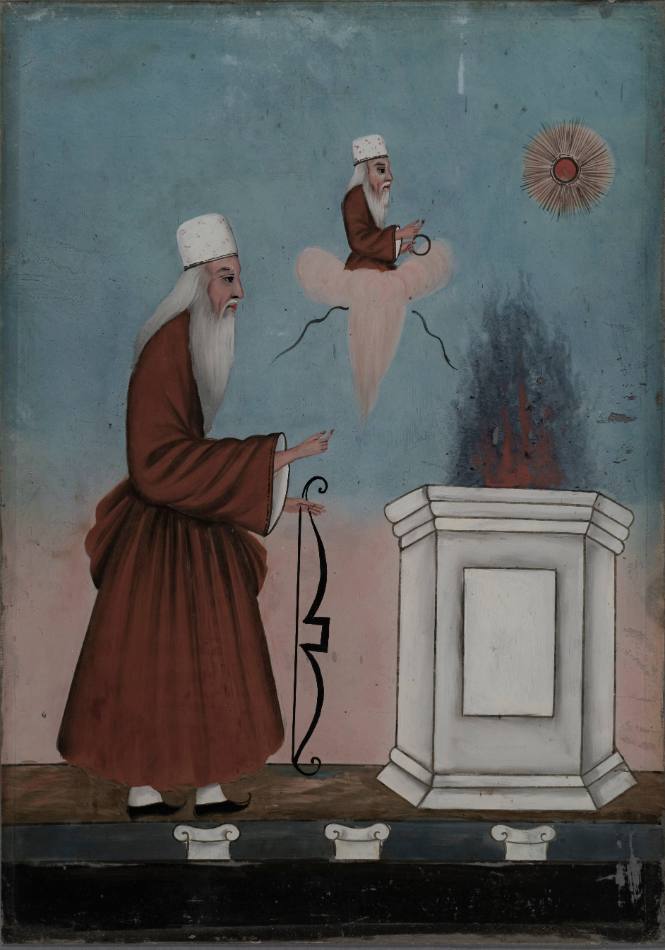
Zoroaster and Ahura Mazda
Datec. 1800-1810
Artist
Indian / Chinese
(Indian / Chinese, NA)
CultureIndian or Chinese
MediumOil on glass
DimensionsFramed: 22 x 16 1/4 in. (55.88 x 41.28 cm)
Unframed: 20 x 14 1/4 in. (50.8 x 36.2 cm)
Unframed: 20 x 14 1/4 in. (50.8 x 36.2 cm)
Credit LinePurchase, Lydia Evans Tunnard, class of 1936, Fund
On View
Not on viewPeriod19th c
Classification(s)
Label TextThough often predominantly associated with the traditions of Hinduism, Buddhism, and Jainism, India has long been home to many faiths, as merchants, diplomats, artisans, and travelers spent time in the subcontinent. Practitioners of Zoroastrianism, a pre-Islamic tradition founded around the sixth century BCE, fled persecution in their native Iran and established communities near Mumbai, and their descendants became known as Parsis. The tradition's founder, Zarathustra, aimed to reform the dominant pantheism by directing worship to a single deity, Ahura Mazda, represented as the sun in this painting. Zarathustra, also referred to as Zoroaster, stands before a fire offering inside a white altar, as a part of himself is shown in continuous narrative above, traveling upward to receive a revelation from Ahura Mazda.
Object information is a work in progress and may be updated as new research findings emerge.
To help improve this record, please email
loebcollections@vassar.edu