Object number1963.8
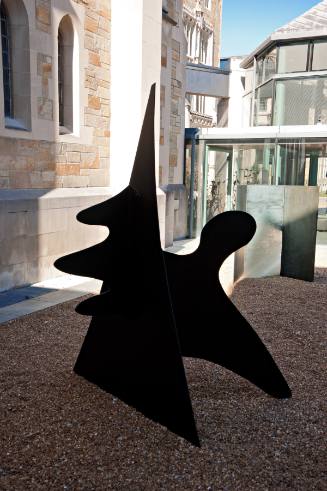
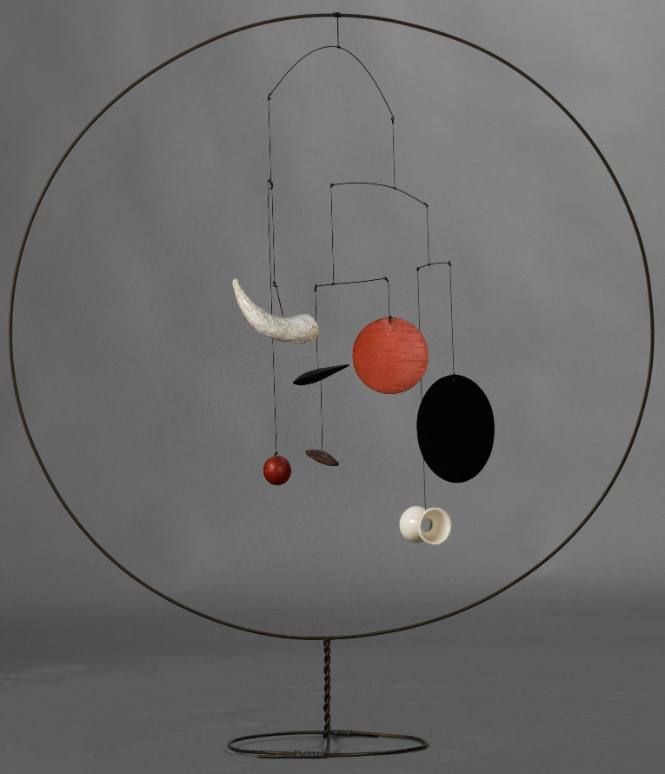
Mobile
Date1934
Artist
Alexander Calder
(American, 1898-1976)
CultureAmerican
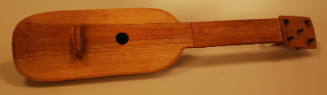
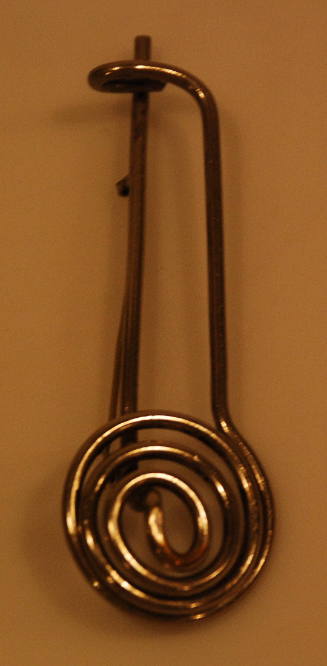
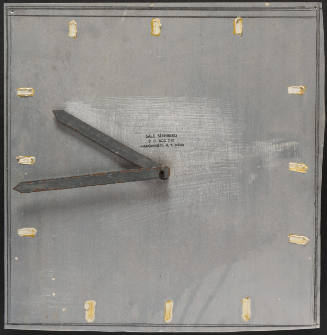
MediumSheet aluminum, ceramic, wood, string and steel wire
DimensionsOverall: 35 13/16 x 31 1/2 x 31 1/2 in. (91 x 80 x 80 cm)
Credit LineGift of Agnes Rindge Claflin
Period20th c
Classification(s)
Gifted to Vassar College, 1963
Exhibition HistoryHartford, CT, Avery Memorial, "Calder Mobiles," April 1936;
New York, NY, Museum of Modern Art, "Calder," October - December, 1943;
London, England, Tate Gallery / Arts Council of Great Britain, "Calder Retrospective," July - August, 1962;
New York, NY, The Solomon R. Guggenheim Museum, "Alexander Calder Retrospective," November 5, 1964 - January 17, 1965;
Williamstown, MA, Williams College Museum of Art, "Williams - Vassar Exchange Exhibition," February 28 - March 18, 1966;
New York, NY, Whitney Museum of American Art, "Calder's Universe," October 12 - February 6, 1977;
Poughkeepsie, NY, FLLAC, Vassar College, "An Exhibition in Memory of Agnes Rindge Claflin 1900-1977," April 30 - June 4, 1978;
New York, NY, Whitney Museum of American Art, "Alexander Calder: Abstract Sculptures of the 1930s," November 12, 1987 - January 17, 1988;Washington, D.C., National Gallery of Art, "Alexander Calder 1898-1976", March 29 - July 12, 1998,
San Francisco Museum of Art, September 5 - December 1, 1998;
Calder: Dreaming in Equilibrium, Fondation Louis Vuitton, Paris, France, April 15 - August 16, 2026;
Label TextIn 1931, Alexander Calder introduced a new sculptural art form—the mobile — and thus embarked on what would prove to be the most fertile decade of his career. This followed on the heels of a life-altering visit he paid to the Paris studio of Piet Mondrian in 1930, at which time he began to understand the nature of abstraction and his desire to work in this manner. Prior to this time his work had consisted largely of bent wire ‘drawings’ in a simple yet representative mode. The Circle is part of a small group of early mobiles on fixed bases that Calder produced in the mid-1930s. In January 1935 Calder wrote to ‘Chick’ Austin, director of the Wadsworth Athenaeum in Hartford, offering him The Circle, which was then housed in the studio of Calder’s father, for an upcoming exhibition. In this letter he gave very detailed instructions on its installation. The sculpture was exhibited at Vassar in the spring of 1936 and bought by Vassar art professor Agnes Rindge at that time.
Object information is a work in progress and may be updated as new research findings emerge.
To help improve this record, please email
loebcollections@vassar.edu