Object number2025.22.4
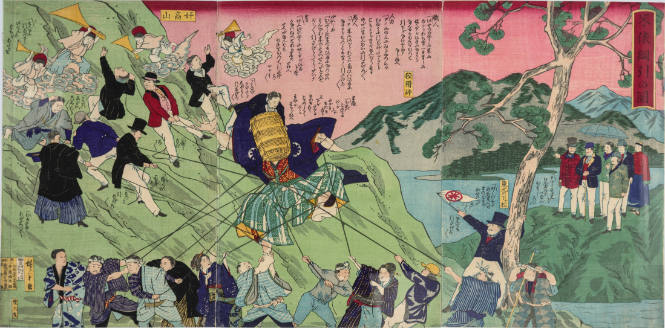
Rice Inflation Satire: Picture of Tug of War with a Personified Bale of Rice
Date1880
Publisher
Hayashi Kichizô
CultureJapanese
MediumWoodblock print (nishiki-e); ink and color on paper
DimensionsComposition: 13 15/16 x 28 3/8 in. (35.4 x 72 cm)
Sheet: 14 x 9 1/2 in. (35.5 x 24.1 cm)
Sheet: 14 x 9 1/2 in. (35.5 x 24.1 cm)
Credit LinePurchase, Betsy Mudge Wilson, class of 1956, Memorial Fund
Period19th c (Meiji period)
Classification(s)
Vassar Exhibitions
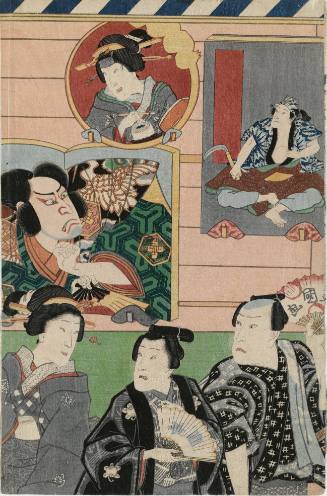
Label TextUtagawa Hiroshige III addresses the topic of rice inflation in this satirical print. While kaika-e (civilization pictures) showcased the beauty of modernization through the lens of Westernization, political satire prints, such as this, showcase the tensions that accompany government transition and modernization. During the Meiji period, paper currency was introduced, transitioning from the rice-based economy of the Edo period—however, nothing physical backed the money in circulation. Simultaneously, rice crops from 1877 to 1881 produced lower-than-average yields, resulting in price inflation.
Produced during this turbulent time, this hectic composition depicts a struggle between Japanese citizens and merchants over a large figure with a bale of rice in place of his head. Hovering on clouds are messengers of Amaterasu, the Shintō sun goddess and ancestor to the imperial family. In a visual pun, the messengers are striking the merchants in the upper-left panel with shamisen picks called bachi—a homophone of bachi means “punishment.” According to a translation of the print’s inscription by Michiko Sato-Grube, the rice-bale man says, “Some want me to go down, and others want me to go up. I don’t care much which way. It’s a bit confusing!” The public attempts to pull the personified rice bale down, thereby bringing down the price of rice. A man wearing a top hat in the lower right of the composition brandishes a flag with the kanji for rice written in red. His text reads, “Thirty-five million people [referring to the Japanese population at the time] earned it! Pull down!”
Object information is a work in progress and may be updated as new research findings emerge.
To help improve this record, please email
loebcollections@vassar.edu
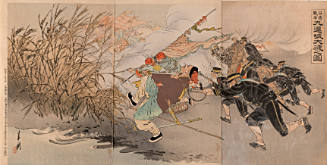
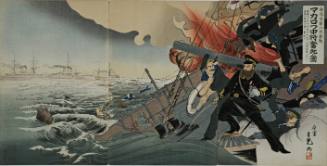
Toshimitsu
1894
Culture: Japanese
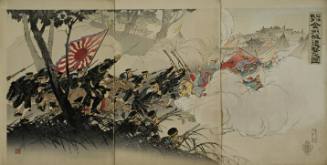

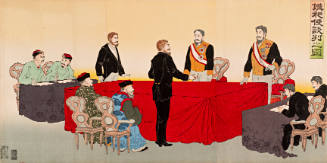
Migita Toshihide
1895
Culture: Japanese