Object number2025.18
Maria
Date2021
Artist
Rose B. Simpson
(Khaʼpʼoe Ówîngeh, born 1983)
Printer
Valpuri Remling
(Finnish)
CultureKha'p'oe Ówîngeh
MediumLithograph
EditionEdition 26 of 30, plus 1 bon a tirer, 3 artist's proofs, 3 press impressions, 1 presentation proof, 1 color trial proofs, 1 trial proof signed
DimensionsSheet (each): 18 x 46 in. (45.7 x 116.8 cm)
Credit LinePurchase, Suzette Morton Davidson, class of 1934, Fund
On View
Not on viewPeriod21st c
Classification(s)
SignedOn recto of Component a, signed lower left next to wheel well in pencil. On recto of Component b, signed lower right next to wheel well in pencil.
InscribedOn verso of Component a, by unidentified hand, center in pencil: [left of publisher's chop] 26/30 [above publisher's chop] 21-305 / [below publisher's chop] 0m [right of printer's chop] '21. On verso of Component b, by unidentified hand, center in pencil: [left of publisher's chop] 26/30 [above publisher's chop] 21-305A / [below publisher's chop] 0m [right of printer's chop] '21.
MarkingsOn verso of Components a and b, stamped center in ink: Tamarind Institute chop [outline of bell shape bisected by vertical line terminating in a smaller, horizontal line]; collaborating printer's chop [image of hand with pointer and middle fingers upright making a peace sign].
Vassar Exhibitions
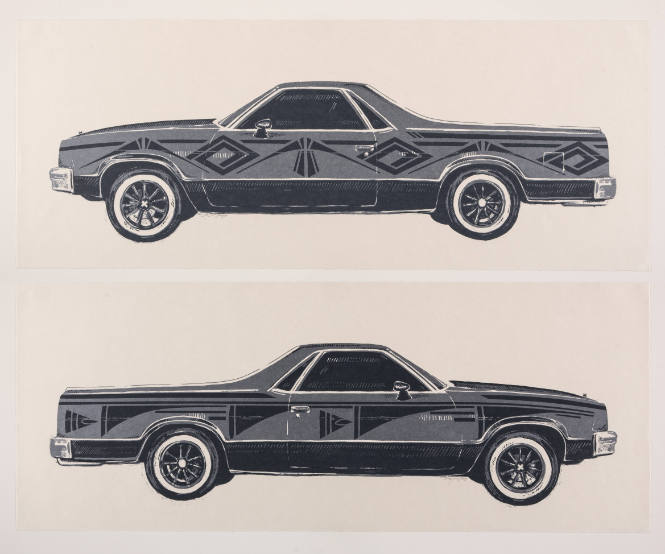
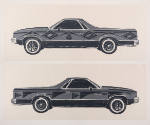
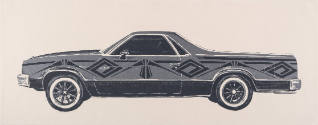
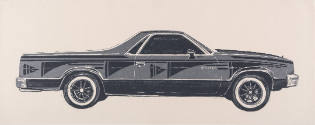
Label TextThis diptych captures Rose B. Simpson’s restored and customized 1985 Chevy El Camino, which she painted to resemble the iconic black-on-black pottery of the Tewa artists Maria and Julian Martinez, and named in Maria’s honor. Both the prints and the physical car are Simpson’s tributes to the traditional pottery of the Martinezes’ San Ildefonso Pueblo, but also Simpson’s own ancestors, as she comes from a line of nearly seventy generations of potters and ceramicists. Simpson, both an artist and trained auto mechanic, honors her family legacy by merging car culture and claywork. In her words, “I have the utmost amount of reverence for the Tewa potters who have come before me... When I look at the wall of a particularly sharp Maria Martinez vessel, I see myself. I see the simultaneous layers of existence I navigate….We are here together through time.”
In Maria, Simpson also reclaims the lowrider, a symbol of masculine power in Española, New Mexico. She transforms it into a symbol of feminine strength and cultural continuity, because cars, just like pottery, are vessels of care that safeguard and transport cargo. Maria’s geometric patterns create a visual language that echoes the Martinezes’ innovative black-on-black pottery, connecting design, place, and identity across generations.
Object information is a work in progress and may be updated as new research findings emerge.
To help improve this record, please email
loebcollections@vassar.edu