Object number2022.20.2
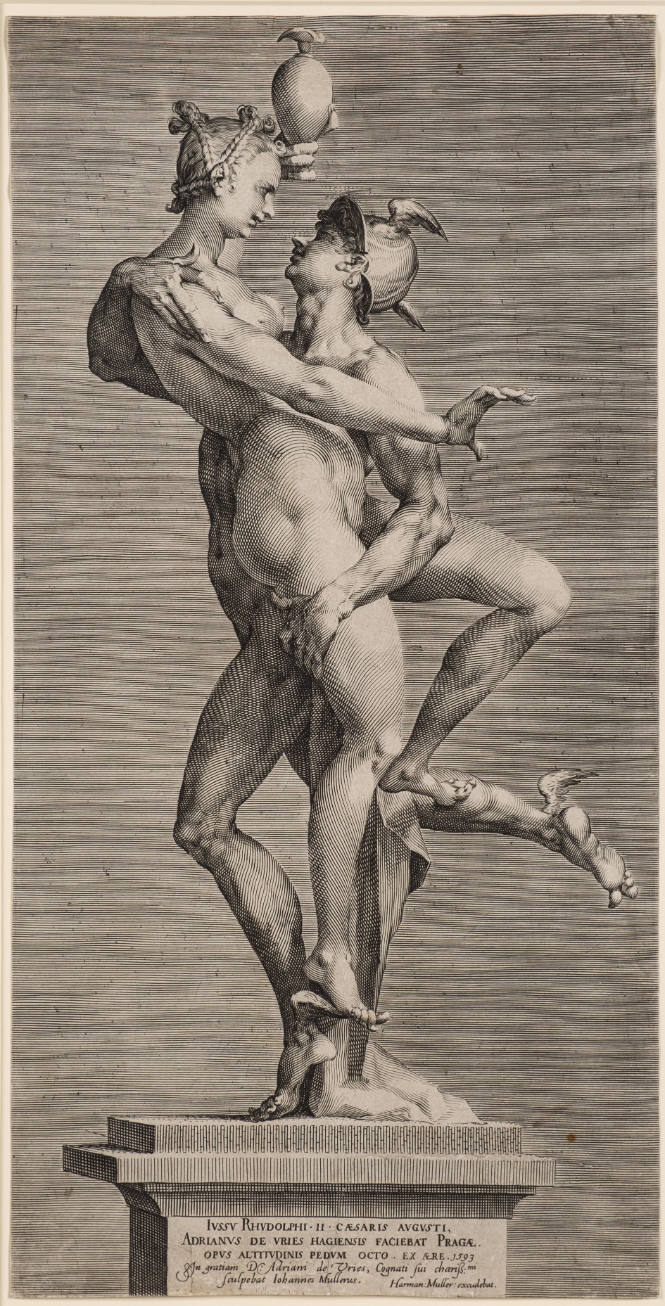
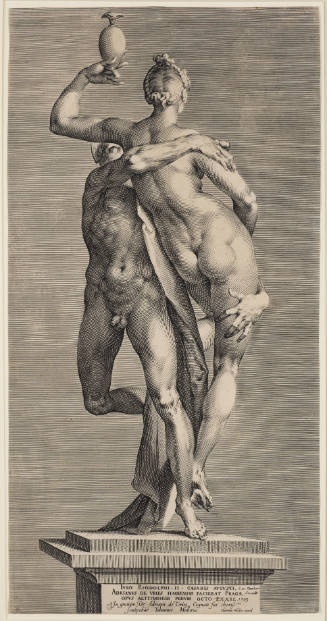
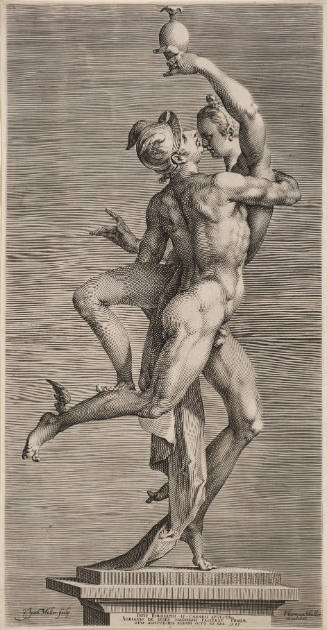
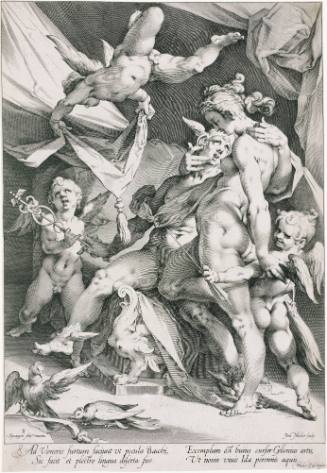
Mercury Abducting Psyche
Datec. 1594-1595
Artist
Jan Harmensz Müller
(Dutch, 1571-1628)
after
Adriaen de Vries
(Dutch, c. 1545 - 1626)
CultureDutch
MediumEngraving
DimensionsImage: 20 1/4 x 10 1/8 in. (51.4 x 25.7 cm)
Credit LinePurchase, gift of Mrs. Frederick Ferris Thompson, by exchange
On View
Not on viewPeriod16th c
Classification(s)
InscribedOn verso, by unidentified hand in pencil: zu 53157
Catalogue raisonnéBartsch 82–84; Hollstein 56–58; New Hollstein (The Muller Dynasty, vol. 2) 82–84BibliographyKok, Jan Piet Filedt. “Jan Harmensz. Muller as Printmaker – I.” Print Quarterly 11, no.3 (September 1994): fig. 117, 118, pp. 236-240
Kubíková, Blanka and Alena Volrábová. From Michelangelo to Callot: The Art of Mannerist Printmaking. Exhibition catalogue. Prague: the National Gallery in Prague, 2024, cat. 161, pp. 375-377
Luijten, Ger and Ariane van Suchtelen, ed. Dawn of the Golden Age: Northern Netherlandish Art 1580–1620. Exhibition catalogue. Amsterdam: Rijksmuseum, Waanders Publishers, Zwolle, 1993, cat. 180, pp. 72-73, 180, 312
Mielke, Hans. Manierismus in Holland um 1600: Kupferstiche, Holzschnitte und Zeichnungen aus dem Berliner Kupferstichkabinett. Exhibition catalogue. Berlin: Kupferstichkabinett, 1979, cat. 22
Schaar, Eckhard, and Holger Broeker. Invenit et sculpsit: Zeichnungen und Graphik des Niederländischen Manierismus. Exhibition catalogue. Stuttgart, Germany: Gerd Hatje and Hamburger Kunsthalle, 1992, cat. 67
Scholten, Frits, et al. Adriaen de Vries 1556–1626. Exhibition catalogue. Amsterdam: Rijksmuseum, Zwolle, Netherlands: Waanders Publishers, 1998, cat. 58
Schultze, Jürgen. Prag Um 1600: Kunst Und Kultur Am Hofe Rudolfs II. Exhibition Catalogue. Freren, Germany: Luca Verlag, 1988, cat. 84, p. 174ProvenanceCollection of Robert M. Light; private collection; C.G. Boerner, NYCVassar Exhibitions
Label TextJan Harmensz Müller’s three engravings translate Adriaen de Vries’s bronze sculpture through front, rear, and oblique views, constructing a virtual rotation around the spiraling figures. Cast in 1593 for Emperor Rudolf II’s court in Prague, the eight-foot sculpture never reached Müller directly. Working from a smaller wax model, he dedicated the frontispiece to “Adriaen de Vries cognato suo charissimo”—his dearest relative. Müller had trained with Hendrick Goltzius, a master engraver of Haarlem, learning the swelling lines and idealized forms that characterized Northern Mannerist printmaking. His dense, almost concentric hatching crosses at sharp angles while contours flow seamlessly into shadow. Müller doesn’t simply reproduce de Vries: Psyche’s expression grows more capricious, and anatomical contours elongate beyond classical restraint. This represents a sophisticated response to paragone—the Renaissance debate over which art form was superior, painting or sculpture. Müller demonstrates engraving’s unique capacity to think sculpturally, activating rotation and depth through linear means. The rear view achieves rich textures that mimic bronze’s sheen while Mercury’s forward momentum feels almost cinematic across the three plates.
DescriptionDepiction of the sculpture Adriaen de Vries had cast for Emperor Rudolph II in Rome in 1593 (now in the Louvre.)
Object information is a work in progress and may be updated as new research findings emerge.
To help improve this record, please email
loebcollections@vassar.edu
![[Mailboxes in Maine]](/internal/media/dispatcher/18618/thumbnail)