Object number2021.27.3
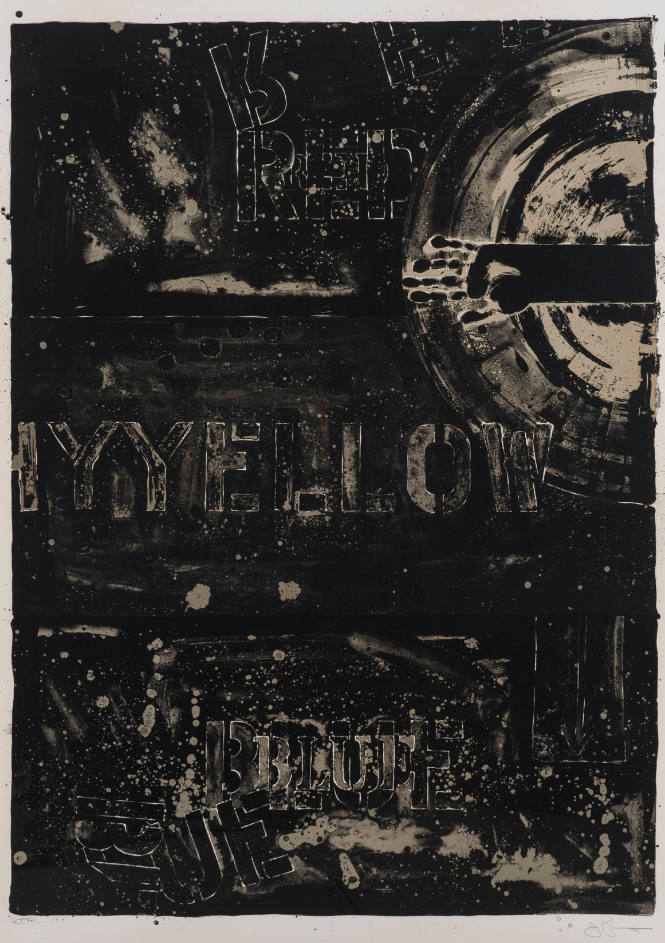
Periscope II
Datec. 1979
Artist
Jasper Johns
(American, 1930-)
CultureAmerican
MediumLithograph printed in black and transparent black from seven aluminum plates on Arches 88 paper
DimensionsImage: 56 x 40 3/4 in. (142.2 x 103.5 cm)
Sheet: 56 x 40 3/4 in. (142.2 x 103.5 cm)
Framed: 59 1/8 x 44 1/8 x 2 in. (150.2 x 112.1 x 5.1 cm)
Sheet: 56 x 40 3/4 in. (142.2 x 103.5 cm)
Framed: 59 1/8 x 44 1/8 x 2 in. (150.2 x 112.1 x 5.1 cm)
Credit LineGift of Neil Peter Jampolis and Jane Reisman Jampolis, class of 1959
On View
Not on viewPeriod20th c
Classification(s)
SignedLR in pencil "JJL '79"
InscribedInscribed_ Gemini G.E.I., 831; RTP impression
Markingswatermark LL margin
Catalogue raisonnéULAE no. 201, Gemini 841BibliographyGoldman, Judith. Jasper Johns: Prints 1977-1981. Boston, MA: Thomas Segal Gallery, 1981, no. 15.
Vassar Exhibitions
Label TextWhat whisperings of far watches on the main Relapsing into silence, while time clears
Our lenses, lifts a focus, resurrects
A periscope to glimpse what joys or pain Our eyes can share or answer—then deflects Us, shunting to a labyrinth submersed
Where each sees only his dim past reversed . . .
—Hart Crane, “Cape Hatteras” (1930)
A white hand floats against gray lithographic tone, fingers extended but grasping nothing, while three bands stenciled RED, YELLOW, BLUE offer an unfulfilled promise of color. The semicircular arc traces Jasper Johns’s compass technique, a ruler attached to the surface and dragged through medium to form mechanical curves that interrupt the hand’s reach. The lithograph reproduces Johns’s 1963 painting Periscope (Hart Crane), made during the end of his relationship with Robert Rauschenberg and informed by poet Hart Crane’s suicide by drowning. Johns had moved to a studio near Cape Hatteras in 1961, and Crane’s poem provided both the work’s title and its central metaphor: the periscope as an instrument of indirect vision, of looking through concealment and deflection. The poem traces memory’s changes over time, how “each sees only his dim past reversed.” Here, mechanical mark meets
human touch, color words drift without color, and what appears refuses what’s named.
Object information is a work in progress and may be updated as new research findings emerge.
To help improve this record, please email
loebcollections@vassar.edu