Object number2020.13.2
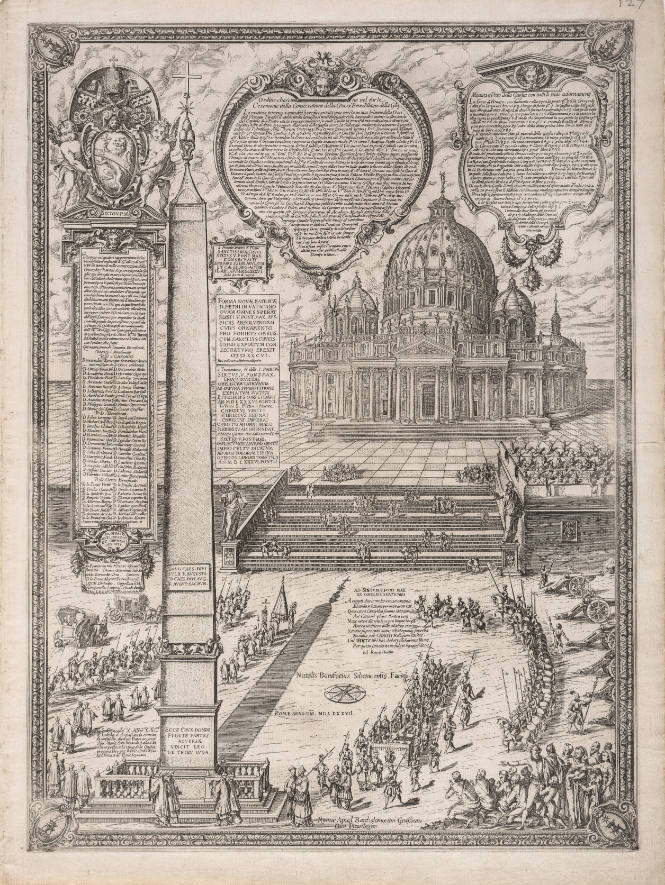
Consecration of the cross on the obelisk, with Saint Peter's projected as complete
Date1587
Artist
Natale Bonifacio da Sebenico
(Italian, 1537 - 1592)
after
Giovanni Guerra
(Italian, c. 1540–1618)
Artist
Bartolomeo Grassi
(Italian, c. 1553–after 1595)
CultureItalian
MediumEngraving on paper, stiching holes along left edge
DimensionsImage: 19 7/8 x 14 1/2 in. (50.5 x 36.8 cm)
Sheet: 21 5/8 x 16 3/8 in. (54.9 x 41.6 cm)
Sheet: 21 5/8 x 16 3/8 in. (54.9 x 41.6 cm)
Credit LinePurchase, Betsy Mudge Wilson, class of 1956, Memorial Fund
On View
Not on viewPeriod16th c
Classification(s)
MarkingsWatermark: letter M and six-pointed start within shield (probably a Fabriano paper)
Bibliography Armani, Elena Parma, et al. Libri di immagini, disegni e incisioni di Giovanni Guerra (Modena 1544–Roma 1618). Modena: Palazzo dei Musei, 1978, cat. 80, pp. 87–88
Boorsch, Suzanne. “The Building of the Vatican.” The Metropolitan Museum of Art Bulletin XL, no. 3 (1983): 21-23
Vassar Exhibitions
Label TextNatale Bonifacio’s engraving, once bound in an illustrated book, operates as both document and fabrication. The print commemorates Pope Sixtus V’s consecration of the bronze cross atop the Vatican Obelisk in September 1587, depicting Saint Peter’s Basilica as fully completed—projecting architect and painter Giovanni Guerra’s designs while construction was still underway. Originally transported from Heliopolis by Caligula, the ancient obelisk had been repositioned by engineer Domenico Fontana the previous year. Bonifacio captures the liturgical ceremony that followed—a papal demonstration of Counter-Reformation authority. Guerra’s design emphasizes symmetry and centralization, formal strategies mirroring the pope’s urban reforms. Processional figures populate the square, their small scale amplifying the monumentality of the architecture. This engraving concludes a four-part series chronicling the obelisk’s edification. Earlier plates focused on engineering; this final image shifts toward theological symbolism, staging architectural completion decades before reality.
Object information is a work in progress and may be updated as new research findings emerge.
To help improve this record, please email
loebcollections@vassar.edu
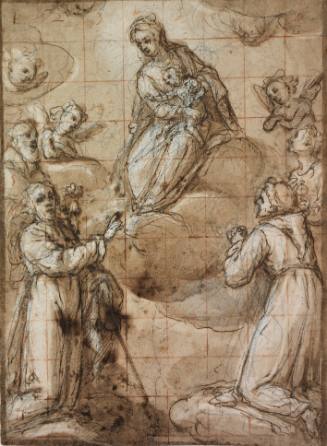
Jacopo da Empoli
n.d.
Culture: Italian
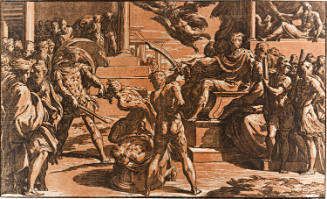
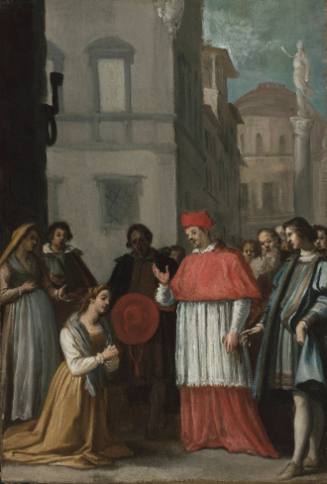
Jacopo da Empoli (Jacopo Chimenti)
c. 1613
Culture: Italian