Object number2017.4
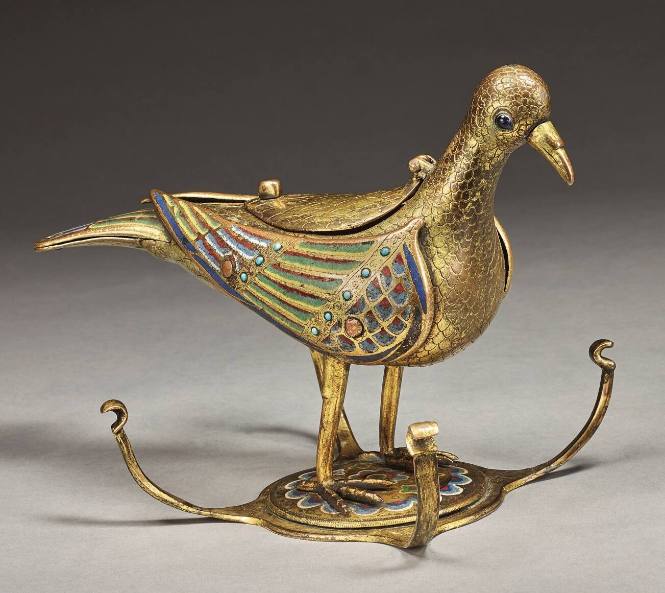
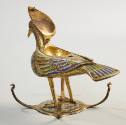
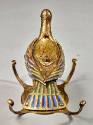
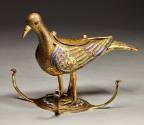
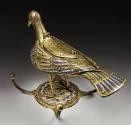
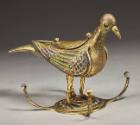
Eucharistic Dove
Date1215-1235
Artist
Currently Unidentified
CultureFrench
MediumChamplevé enamel, parcel gilt and engraved copper, circular base and hinged lid later
DimensionsOverall: 7 7/8 × 7 1/2 × 9 13/16 in. (20 × 19 × 25 cm)
Credit LinePurchase, gift of Mrs. Frederick Ferris Thompson, by exchange, in memory of Andrew J. Tallon, (Associate Professor of Art, Vassar College, 2007-2018)
On View
On viewPeriod13th c
Classification(s)
274; European Private Collection; purchased by Frances Lehman Loeb Art Center 2017.
Vassar Exhibitions
Label TextThis opulent dove is one of about forty such objects known today, only six of which are in American museums. They were produced in thirteenth-century Limoges, a French city known in the Medieval period for its enamel industry. According to historical accounts, such a dove would be suspended by chains above the church altar. For contemporaries, an encounter with this object would have likely evoked the Holy Spirit, commonly represented in Christian imagery as a hovering dove. A small compartment, in this instance on the back of the bird, would have held wafers consecrated during the liturgy of the Eucharist.
Object information is a work in progress and may be updated as new research findings emerge.
To help improve this record, please email
loebcollections@vassar.edu





Classical (Ancient European: Greek / Italian?)
3rd-2nd c BCE
Culture: Italian, Greek