Object numberX.254
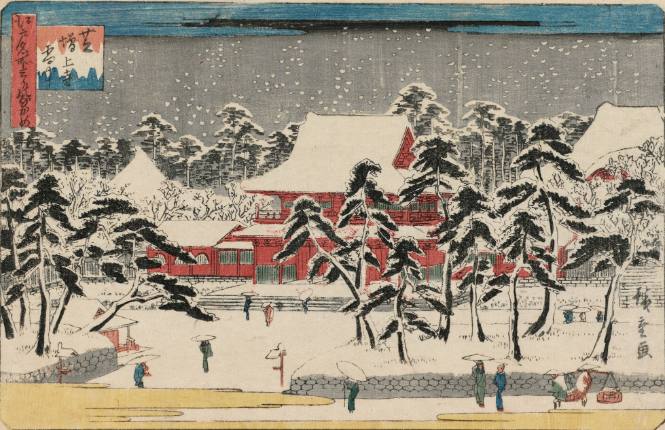
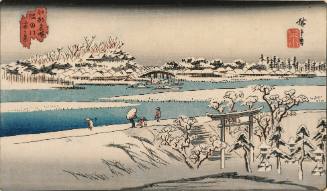
Zōjō-ji Temple at Shiba in the Snow
Portfolio/Seriesfrom the series Three Views of Famous Places in Edo
Date1839-1842
Artist
Utagawa Hiroshige (歌川 広重)
(Japanese, 1797-1858)
CultureJapanese
MediumWoodblock print (nishiki-e); ink and color on paper
DimensionsImage: 8 11/16 x 13 3/4 in. (22 x 35 cm)
Sheet (Horizontal ōban): 9 13/16 x 14 9/16 in. (25 x 37 cm)
Sheet (Horizontal ōban): 9 13/16 x 14 9/16 in. (25 x 37 cm)
Period19th c (Edo period)
Classification(s)
SignedOn recto, lower right, signed in block: 広重画 (Hiroshige ga)
InscribedOn recto, upper left, in block: 江戸名所三つの眺め (Three Views of Famous Places in Edo (Edo Meisho mittsu no nagame); 芝増上寺雪中 (Snow at Zōjō-ji Temple in Shiba (Shiba Zōjō-ji setchū)
Vassar Exhibitions
Label TextDuring the Edo period, Buddhist temples had political connections to the government and were used as a means of social control. Zōjōji Temple became the Tokugawa family’s personal temple and was moved from present-day Kōjimachi to Shiba, the location mentioned in the print’s title. The Tokugawa shogunate required all Japanese households to affiliate with Buddhist temples. While it initially started as a means to suppress and extinguish the spread of Christianity in Edo-period Japan, by the end of the period, the system functioned to track and control its population.
Object information is a work in progress and may be updated as new research findings emerge.
To help improve this record, please email
loebcollections@vassar.edu

Utagawa Hiroshige (歌川 広重)
c. 1832-1838
Culture: Japanese
![[Mandarin Ducks and Nandina in Snow]](/internal/media/dispatcher/3980/thumbnail)