
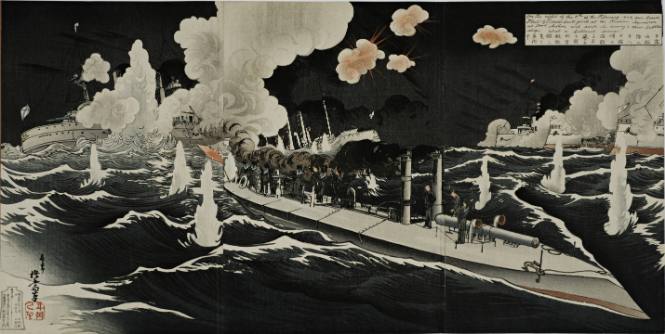
Object number2008.19.29
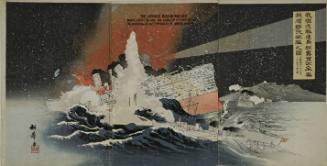
On the Night of the 8th of February, Our Brave Fleet of Torpedo Boats Fired at the Russian Aquadron at Port Arthur and Sank the Enemy’s Three Battleships. What a Brilliant Success!
Date1904
Artist
Migita Toshihide
(Japanese, 1863-1925)
CultureJapanese
MediumWoodblock print (nishiki-e); ink and color on paper
DimensionsSheet (ōban tate-e): 14 x 9 1/4 in. (35.6 x 23.5 cm)
Overall: 14 x 27 3/4 in. (35.6 x 70.5 cm)
Mount: 18 x 31 in. (45.7 x 78.7 cm)
Matted: 20 x 33 in. (50.8 x 83.8 cm)
Overall: 14 x 27 3/4 in. (35.6 x 70.5 cm)
Mount: 18 x 31 in. (45.7 x 78.7 cm)
Matted: 20 x 33 in. (50.8 x 83.8 cm)
Credit LineGift of Frances Beatty Adler, class of 1970, and Allen Adler
Period20th c (Meiji period)
Classification(s)
SignedSigned: Oju Toshihide; (sealed: Toshihide no in)
Vassar Exhibitions
Label TextA triptych by Migita Toshihide depicts the Imperial Japanese Navy’s ambush of the Russian-controlled Port Arthur (modern-day Dalian, China, in the Liaodong Peninsula) in Manchuria. In this night scene, spray from artillery fire surrounds a Japanese destroyer as its crew, undisturbed, watches and celebrates a Russian battleship sinking. In the upper right, the title, written in both English and Japanese, suggests the publisher’s intent to circulate this print abroad, showing the strength of the Japanese military forces in the face of a major imperial power. War prints (sensō-e) depicting battles were used to highlight Meiji forces using modern Western technology to triumph over the Western threat and enhance Japanese society, embodying the saying “enrich the country, strengthen the military.” While instigating the Russo-Japanese War, the surprise attack on Port Arthur was, in fact, less than successful. The Japanese had to withdraw the next day (right) after a failed neutralization attempt, having left several Russian ships intact. Eventually, however, the Russo-Japanese War would end in victory for Japan, strengthening the nation’s position among European imperial powers.
Object information is a work in progress and may be updated as new research findings emerge.
To help improve this record, please email
loebcollections@vassar.edu
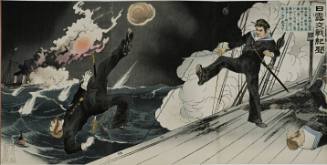
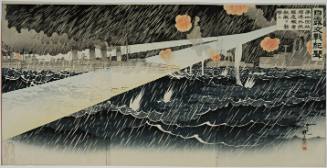
Migita Toshihide
1904
Culture: Japanese
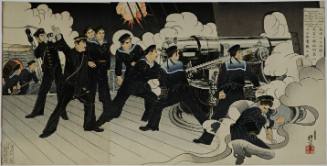
Migita Toshihide
1904
Culture: Japanese
Migita Toshihide
1895
Culture: Japanese
Yasuda Hanpo
1904
Culture: Japanese

Migita Toshihide
1895
Culture: Japanese
Toshimitsu
1894
Culture: Japanese