
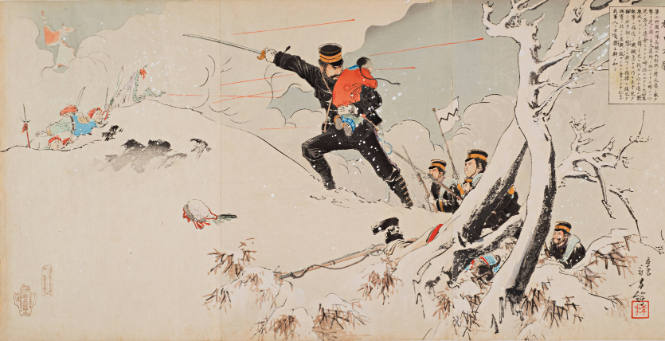
Object number2008.19.35
Captain Higuchi
Date1895
Artist
Mizuno Toshikata
(Japanese, 1866-1908)
Published by
Sekiguchi Masajiro
CultureJapanese
MediumWoodblock print (nishiki-e), ink and color on paper
DimensionsSheet (each, oban tate-e): 13 3/4 x 9 13/16 in. (35 x 25 cm)
Overall: 13 11/16 x 27 1/2 in. (34.8 x 69.8 cm)
Matted: 20 x 33 in. (50.8 x 83.8 cm)
Overall: 13 11/16 x 27 1/2 in. (34.8 x 69.8 cm)
Matted: 20 x 33 in. (50.8 x 83.8 cm)
Credit LineGift of Frances Beatty Adler, class of 1970, and Allen Adler
Period19th c (Meiji period)
Classification(s)
SignedRight sheet, lower right, artist's signature, in block: 応需年方絵 (Ōju Toshikata e)
MarkingsLeft sheet, lower left, publisher's date seal: 明治廿八年四月十九日印刷 (printing: April 19, 1895 ); 仝 年仝月廿三日発行 (published: April 23, 1895)
Left sheet, lower left, publisher's seal: 関口政治郎 (Sekiguchi Masajirō) [Marks: pub. ref. 462; seal not shown]
Vassar Exhibitions
Label TextThe print by Mizuno Toshikata depicts the Imperial Japanese Army Captain Higuchi Seizaburō facing enemy fire while gallantly hoisting a young Chinese child over his shoulder. The subject of Higuchi rescuing a Chinese child was very popular and frequently depicted, sometimes reinterpreted with the child’s mother hiding behind a rock or the father kneeling before the captain. At the print’s core is the propagation of the Imperial Army’s reputation for compassion. Humanitarianism thus became a powerful propaganda tool for Japanese artists. In Captain Higuchi, Japan is portrayed as the savior of China, supporting the claim that the Imperial Army’s efforts in China were necessary. Japan would emerge victorious in the First Sino-Japanese War, reaping many benefits from the 1895 Treaty of Shimonoseki, including Qing territories ceded to Japan, Korea’s independence from China, the payment of reparations, access to Chinese ports, and navigation rights along the Yangtze River.
Object information is a work in progress and may be updated as new research findings emerge.
To help improve this record, please email
loebcollections@vassar.edu
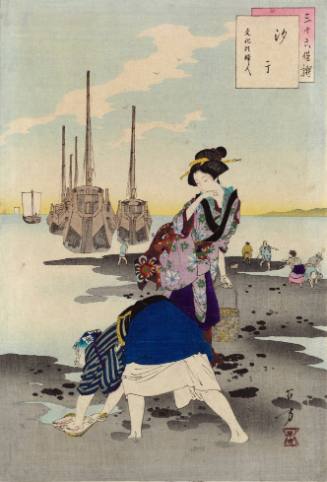
Mizuno Toshikata
1894
Culture: Japanese
Mizuno Toshikata
1894
Culture: Japanese
Mizuno Toshikata
1894
Culture: Japanese
![View of Captain Gunji's Shipwreck off the Chishima Islands [Kuril Islands]](/internal/media/dispatcher/25799/thumbnail)
Utagawa Kokunimasa
1893
Culture: Japanese

Migita Toshihide
1895
Culture: Japanese

Ogata Gekko
1895
Culture: Japanese