Object number2009.32
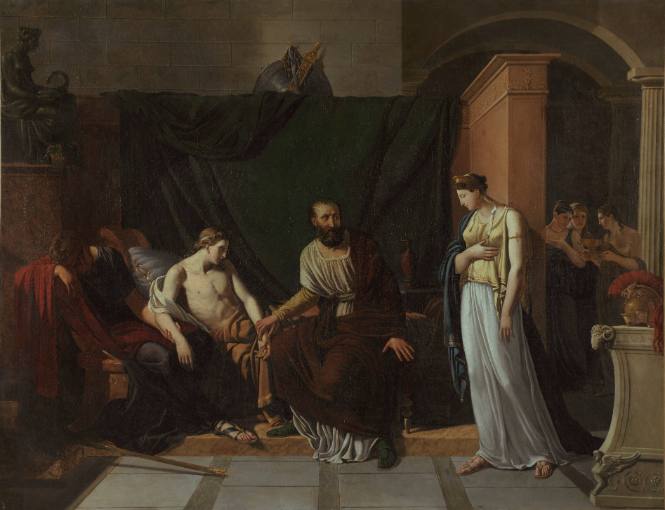
Erasistratus Discovering the Cause of Antiochus’s Disease
Date1808
Artist
Currently Unidentified
CultureFrench
MediumOil on canvas
DimensionsUnframed: 44 x 57 in. (111.76 x 144.78 cm)
Credit LineGift of Jonathan H. Kagan
On View
On viewPeriodLate 18th - early 19th c
Classification(s)
MarkingsWatermark: INGRES
Catalogue raisonnéMongan, Kornfeld, and Joachim 25 iii/iii (canceled; posthumous)ProvenanceNagel Auction, Stuttgart (9/21/2006)Label TextThis painting was an anonymous entry for the Grand Prix de Rome in history painting in 1808. Since the seventeenth century, the French government had awarded the annual prize for this revered category through entries submitted anonymously, with the winner traveling to Rome to study classical art. The subject here considers the ancient Greek physician Erasistratus discovering the cause of a young man’s illness. The doctor deduced that Antiochus harbored a forbidden passion for his father’s beautiful wife, Stratonice. The theme had been successfully undertaken decades earlier by French painter Jacques-Louis David who won the Grand Prix de Rome in history painting with his treatment of the subject in 1774. Our unknown artist borrowed a few elements directly from David’s canvas, including the prominent figure of Stratonice on the right. However, he did not win. A canvas by Alexandre-Charles Guillemot, with the same theme, was chosen and the winning artist identified.
Object information is a work in progress and may be updated as new research findings emerge.
To help improve this record, please email
loebcollections@vassar.edu
Currently Unidentified
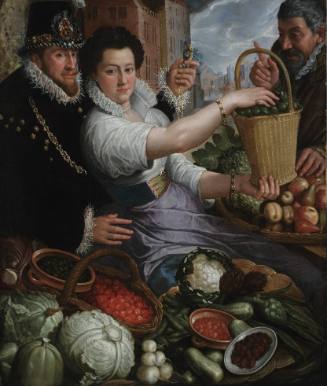
Late 1500s
Culture: Flemish