
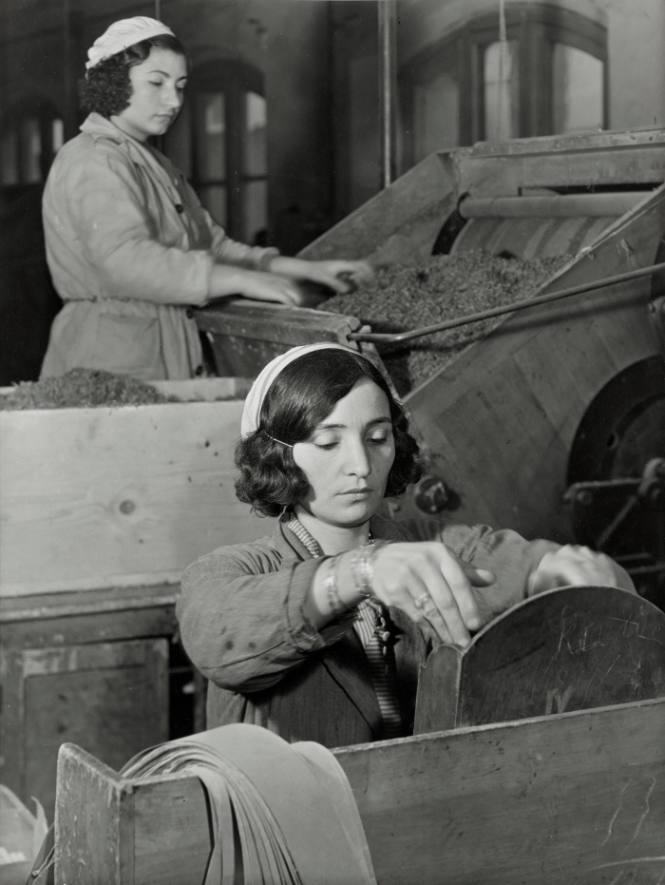
Object number2005.27.3
Turkish Working Class Families
Date1940
Artist
Margaret Bourke-White
(American, 1904-1971)
CultureAmerican
MediumGelatin silver print
DimensionsImage: 9 1/16 x 6 13/16 in. (23 x 17.3 cm)
Sheet: 9 7/16 x 7 3/16 in. (24 x 18.3 cm)
Sheet: 9 7/16 x 7 3/16 in. (24 x 18.3 cm)
Credit LineGift from the Michael and Joyce Axelrod collection (Joyce Jacobson, class of 1961) in honor of Howard Greenberg
On View
Not on viewPeriod20th c
Classification(s)
InscribedOn verso, by unidentified hand, upper half in pencil: pic# / 736402 / 5[circled] Turkish Set / Working class family series / Save as 4; left center: MB 86; upper right corner in blue pencil: B-2; center: X Turkey - '40 / Mahmure Acarle, working mother, in Istanbul Tobacco factory
MarkingsOn verso, stamped upper right in blue ink: 5970
Vassar Exhibitions
Label TextMargaret Bourke-White is recognized as the first American woman to work as a wartime photojournalist. Born in 1904, Bourke-White studied at Cornell University at a time when access to education was limited for women and usually available only to white women of economic privilege. Shortly after graduating in 1927, Bourke-White opened a commercial photography studio in Cleveland, Ohio, where she made a living as a photographer—another rarity for the time. In 1930, Bourke-White became the first Western photographer allowed into the Soviet Union. She traveled overseas again in 1941, first to the Soviet Union, then as a war correspondent for the United States, accompanying the U.S. Air Force and Army across North Africa and Europe. Bourke-White photographed amidst perilous conditions, earning the nickname “Maggie the Indestructible.” After World War II, Bourke-White traveled across Europe, capturing the devastating impacts of war on people and their homes. She later covered the Korean War and partition violence between India and Pakistan, photographing Mahatma Gandhi hours before his assassination. Throughout her prolific career, Bourke-White continuously defied oppressive gender stereotypes and social prescriptions in times of war and peace.
Julia Pippenger ’25
DescriptionBlack and white image of two young Turkish women with short jaw-length hair working in a tobacco factory. The woman in the background stands in three-quarter profile as her hands sift through loose tobacco. The woman in the foreground, Mahmure Acarle, has her hands in front of her, presumably stacking cigarettes.
Object information is a work in progress and may be updated as new research findings emerge.
To help improve this record, please email
loebcollections@vassar.edu
Margaret Bourke-White
1941
Culture: American
Margaret Bourke-White
1942
Culture: American
Margaret Bourke-White
1937
Culture: American