Object number2010.11.2
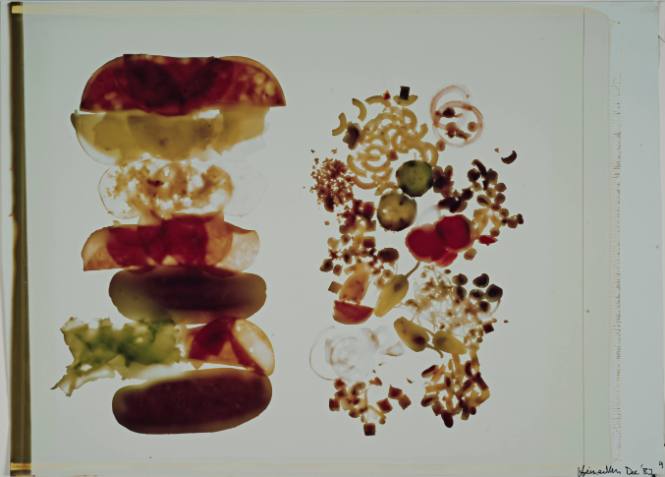
Foodgram #4
Date1983
Artist
Robert Heinecken
(American, 1931-2006)
CultureAmerican
MediumLarge-format Polaroid Polacolor print
DimensionsImage: 20 1/2 x 25 9/16 in. (52 x 65 cm)
Sheet: 21 15/16 x 30 5/16 in. (55.7 x 77 cm)
Matted: 26 7/8 x 34 7/8 in. (68.3 x 88.6 cm)
Sheet: 21 15/16 x 30 5/16 in. (55.7 x 77 cm)
Matted: 26 7/8 x 34 7/8 in. (68.3 x 88.6 cm)
Credit LinePurchase, Horace W. Goldsmith Foundation Fund
On View
Not on viewPeriod20th c
Classification(s)
SignedOn recto, signed lower right margin in ink: Heinecken
InscribedOn recto, by artist, lower right margin in ink: 4 / Dec '83
BibliographyBatchen, Geoffrey. The Art of the Cameraless Photograph. New Zealand: The Govett-Brewster Art Gallery and DelMonico Books/ Prestel, 2016, p.165, pl. 112;
Lombino, Mary-Kay. The Polaroid Years: Instant Photography and Experimentation. New York: DelMonico, 2013, p. 122;
Polaroid Corporation, Selections 2: From Polaroid Collection. Schaffhausen Cambridge Mass. USA: Verlag Photographie ; Polaroid Corp, 1984ProvenanceThe Polaroid Collection;Sotheby's, New York, Photographs from the Polaroid Collection, June 21, 2010, lot 39
Vassar Exhibitions
Exhibition HistoryThe Polaroid Years: Instant Photography and Experimentation, Frances Lehman Loeb Art Center, Vassar College, Poughkeepsie, NY, April 8 - June 30, 2013; The Norton Museum of Art, West Palm Beach, FL, December 19, 2013 - March 23, 2014; Photography as Data: Augmentation, Extraction, Objectification, Frances Lehman Loeb Art Center, Vassar College, Poughkeepsie, NY, April 9 - September 15, 2024Label TextRobert Heinecken made his first photograms of food in 1970. These early works, on traditional black-and-white silver gelatin paper with hand-coloring, were conceived of conceptually as a record of the sustenance Heinecken received when a collector or institution made a purchase of his work. In 1983, Heinecken was invited to use the 20 x 24 inch Polaroid cameras at the Museum of Photographic Arts in San Diego, and at the School for the Museum of Fine Arts, Boston. The Present 'foodgram,' was made in that year. According to Luke Batten, Director of Robert Heinecken Trust, the arrangement of food into two distinct groups provides a commentary on the art world: the meal on the left, with a hamburger, shows the kind of food Heinecken, as a visiting artist, would eat with students in a cafeteria during lunch; the more sophisticated food on the right, with pasta and a variety of vegetables and condiments, comprised the kind of meal he would have with gallerists, or at museum dinners in the evenings. "Robert had a good sense of humor," Batten has related, "and was poking fun at the working class moments of the artist, and conversely, the more elegant moments of one's career." Examples of these foodgrams in the Robert Heinecken Trust have captioning in the artist's hand that outlines the narrative content described above.
DescriptionAn image of a slightly transparent, deconstructed cheeseburger with each element stacked atop one another on left and similarly to vegetables with pasta on right.Terms
Object information is a work in progress and may be updated as new research findings emerge.
To help improve this record, please email
loebcollections@vassar.edu