

Object number2009.5
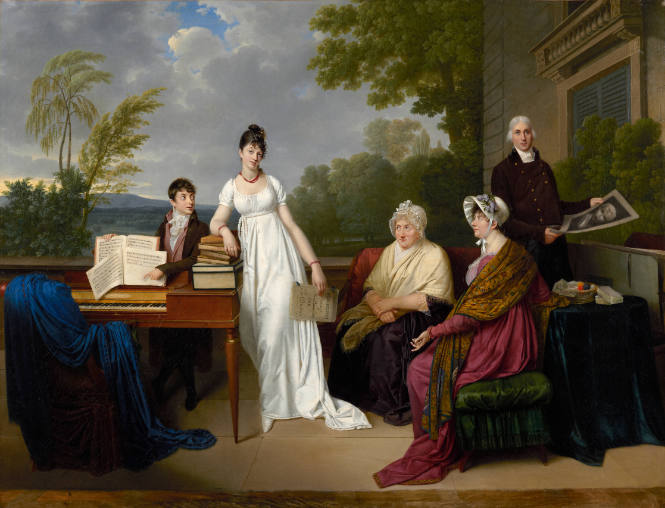
Une jeune personne hésitant à toucher du piano devant sa famille
Date1804
Artist
Adèle Romany
(French, 1769-1846)
CultureFrench
MediumOil on canvas
DimensionsFramed: 56 x 69 x 3 1/2 in. (142.24 x 175.26 x 8.89 cm)
Unframed: 44 1/2 x 57 1/2 in. (113.03 x 146.05 cm)
Unframed: 44 1/2 x 57 1/2 in. (113.03 x 146.05 cm)
Credit LineGift of Mary Bridges Boynton, class of 1936
On View
On viewPeriod18th c / 19th c
Classification(s)
SignedSigned and dated (left center): Adèle.De Romance. 1804
BibliographyBell, Esther and Kelly, Simon. "Degas, Impressionism, and the Paris Millinery Trade". Fine Arts Museum of San Francisco, March 30, 2017;
Lettres impartiales sur les expositions de l'an XIII par un amateur, Paris, an XIII-1804, p. 42;
L'Ovservateur du Salon ou M. Musard au Museum avec sa critique des tableaux en vaudeville, Paris, 1804, p. 21;
Libin, Kathryn L. "Daily Practice, Musical Accomplishment, and the Example of Jane Austen." Jane Austen and the Arts: Elegance, Propriety, and Harmony. Lanham: Leigh UP, 2006. pg. 6-7, repr. p.7, fig.1.1. ProvenanceCollection of the artist; with her descendants in France until 2008.
Jean-Françius Heim Tableaux - Antiquities;
purchased by the Boynton family
Exhibition HistoryParis, Salon of 1804, no. 405, Une jeune personne hésitant à toucher du piano devant sa famille (A young person hesitating to play the piano in front of her family).
Label TextExhibited in the prestigious Paris Salon in 1804, this painting features three generations of artist Adèle Romany’s family. Its carefully rendered objects and fashion speak to some of the roles and expectations for women at the turn of the 19th century, centering on the theme of marriage. Next to a pianoforte, Amélie-Justine Pontois stands in front of an audience that includes her brother, parents, and grandmother. Her classicizing Empire-style gown casts her as both fashionable and virtuous, key elements to attracting marriage suitors. Her mother sports a luxurious cashmere shawl that hints at the promise of financial security within marriage, and covers her hair with a cap, as expected of married women in public. Amélie-Justine’s grandmother, meanwhile, wears a nightcap-like covering, signaling her retirement to domestic life. At the lower right, a basket might allude to the tradition of wedding baskets, part of bridal dowries at the time.
Object information is a work in progress and may be updated as new research findings emerge.
To help improve this record, please email
loebcollections@vassar.edu


Jacques-Charles Bonnard
1809
Culture: French