Object numberX.264
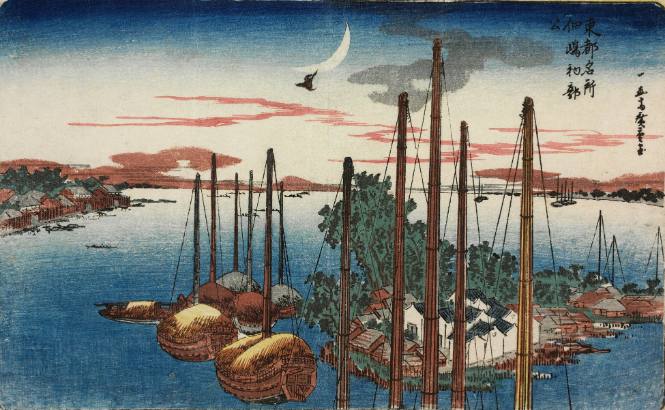
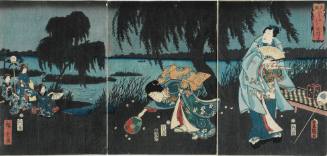
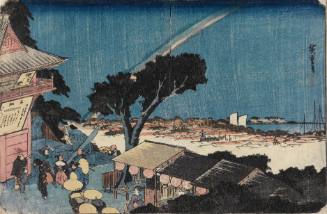
First Cuckoo of the year at Tsukudajima
Portfolio/Seriesfrom the series Famous Places in the Eastern Capital
Date1830-1831
Artist
Utagawa Hiroshige (歌川 広重)
(Japanese, 1797-1858)
Publisher
Kawaguchiya Shōzō (Shōeidō, Eisendō)
(Japanese)
CultureJapanese
MediumWoodblock print (nishiki-e); ink and color on paper
DimensionsImage: 8 11/16 x 13 3/4 in. (22 x 35 cm)
Sheet (Horizontal ōban): 9 7/16 x 14 3/16 in. (24 x 36 cm)
Sheet (Horizontal ōban): 9 7/16 x 14 3/16 in. (24 x 36 cm)
Period19th c (Edo period)
Classification(s)
SignedOn recto, upper right, signed in block: 一幽斎広重画 (Ichiryūsai Hiroshige ga)
InscribedOn recto, upper right, in block: 東都名所 佃島初廓公 (Famous Places in the Eastern Capital (Tōto meisho); (First Cuckoo of the Year at Tsukudajima (Tsukudaijima hatsu hototogisu)
Vassar Exhibitions
Label TextUtagawa Hiroshige’s depictions of places of industry show how non-entertainment–based businesses or facilities were organized by the government. First Cuckoo of the Year at Tsukudajima (left) illustrates boats anchored near Tsukuda Island in Edo Bay at dusk. The island was established by Tokugawa Ieyasu in 1582 when he resettled fishermen from Tsukudamura (in present-day Osaka Prefecture). The island’s main purpose was to supply the shogun with fresh seafood; the surplus was then permitted to be sold to the public. After the Great Meireki Fire in 1657 destroyed more than half of Edo, the shogunate ordered lumberyards throughout the city center to relocate to its outskirts in Fukugawa (right). In a peaceful winter scene made two centuries later, Hiroshige captures two loggers at work amid the snow. In these works, he places these sites in tranquil moments only, far-removed from the bustle of the working class. Romanticized landscapes, Hiroshige’s prints of industry reveal how the professions of the working class were elevated to become consumable products.
Object information is a work in progress and may be updated as new research findings emerge.
To help improve this record, please email
loebcollections@vassar.edu


Utagawa Hiroshige (歌川 広重)
c. 1832-1838
Culture: Japanese