
Object number2008.19.40
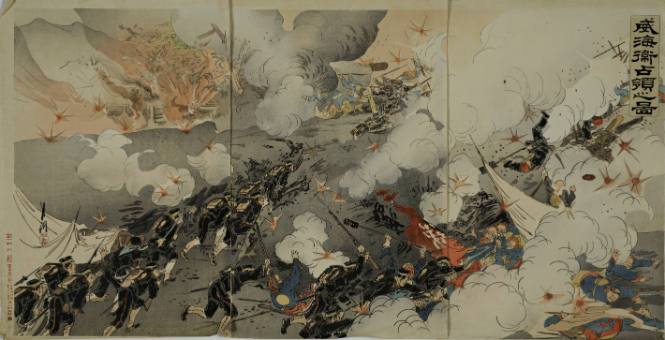
Illustration of the Occupation of Weihaiwei
Date1895
Artist
Ogata Gekko
(Japanese, 1859-1920)
Published by
Takegawa Risaburō
(Japanese)
CultureJapanese
MediumWoodblock print (nishiki-e): ink and color on paper
DimensionsSheet (ōban tate-e): 14 3/4 x 9 13/16 in. (37.5 x 25 cm)
Overall: 14 3/4 x 28 3/8 in. (37.5 x 72.1 cm)
Mount: 18 1/8 x 31 1/8 in. (46 x 79.1 cm)
Matted: 20 x 33 in. (50.8 x 83.8 cm)
Overall: 14 3/4 x 28 3/8 in. (37.5 x 72.1 cm)
Mount: 18 1/8 x 31 1/8 in. (46 x 79.1 cm)
Matted: 20 x 33 in. (50.8 x 83.8 cm)
Credit LineGift of Frances Beatty Adler, class of 1970, and Allen Adler
Period19th c (Meiji period)
Classification(s)
SignedOn recto, lower left (left sheet), artist's signature in block: Gekkō (月耕); (sealed: Gekko)
InscribedOn recto, upper right (right sheet), title in rectangular cartouche: Illustration of the Occupation of Weihaiwei (「威海衛占領之啚」/ Ikaiei senryō no zu)
MarkingsOn recto, lower left (left sheet), artist's seal in block: Gekkō (月耕)
Vassar Exhibitions
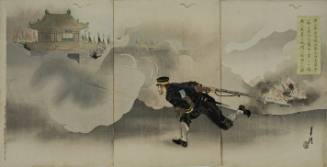
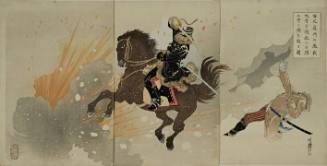
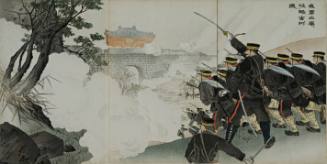
Label TextOgata Gekkō’s triptych shows a sweeping war-scape during the Battle of Weihaiwei (January 20–February 12, 1895) between the Imperial Japanese Army dressed in Western military attire and Chinese forces wearing the traditional military uniforms of the Qing dynasty, with circular rank badges on their chests and backs. The watercolor-like quality of the print is due to a new technique credited to Gekkō and painter Watanabe Seitei called sashiage, where artists painted the colors onto a single proof print. This proof would then be used as a model for the block cutter and printer to interpret the washes and other painterly techniques in woodblock form. This differed from Edo-period woodblock printing techniques where the artist would indicate which colors went where by writing on a preparatory drawing. The gestural and painterly linework used to depict the Imperial Army guides the eye through the composition where plumes of smoke part to reveal Chinese military casualties and disorganized forces.
Object information is a work in progress and may be updated as new research findings emerge.
To help improve this record, please email
loebcollections@vassar.edu

Ogata Gekko
1895
Culture: Japanese

Migita Toshihide
1895
Culture: Japanese
Utagawa Hiroshige, III
1881
Culture: Japanese
Migita Toshihide
1895
Culture: Japanese
Utagawa Kunisada, III
1888
Culture: Japanese