
Object number1981.82
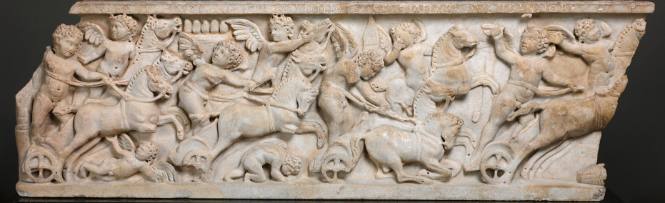
Front panel from a child's sarcophagus
Date3rd c
Artist
Roman
(Roman, NA)
CultureRoman
MediumMarble
DimensionsOverall: 17 1/2 × 58 1/2 × 4 in. (44.5 × 148.6 × 10.2 cm)
Credit LinePurchase, gift of the Friends of the Vassar College Art Gallery and Noma and William Copley, by exchange
On View
On viewPeriod3rd c
Classification(s)
InscribedInscribed (at upper edge): D FLABIVSCHRYSIONPATERETMATFILIAE COSSVTIAFLABIA DVLCISANNORY V?M [Dominus Flavius Chrysion the father, and the mother of the daughter Cossutia Flavia, the sweet one of five years]
BibliographyConstructions of Childhood in Greek and Roman Antiquity (Athens: American School of Classical Studies, 2006);
D’Ambra, Eve. “Racing with Death: Circus Sarcophagi and the Commemoration of Children in Roman Italy.” Hesperia. Supplement 41 (2007): 339–351;
Mundy, James, The Frances Lehman Loeb Art Center: Vassar College The History and Collection (New York: Prestel Publishing, 2007), p. 23
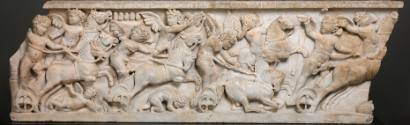
ProvenanceIngrid and Bruce McAlpine, London; Frances Lehman Loeb Art Center (formerly Vassar College Art Gallery), Poughkeepsie, New York, 1981Label TextThis panel from a child’s stone coffin (sarcophagus) depicts a chariot race among winged cupids. The details of this imaginary race are quite accurately rendered, down to the tower-like building decorated with the sculpted eggs used to count the laps around a typical hippodrome. The race itself conveys the action and confusion of horses and riders in pitched competition, some of the characters portrayed in triumph, others crashing in defeat. The custom of holding chariot races as part of funerary games has a long history in ancient Greek and Roman history and literature, going back to the Iliad of Homer in the eighth century BCE. Yet in a symbolic light, this contest might represent the passage of time, with the specter of an early death implied in the defeat of at least one of its childlike contestants. An inscription, which may have been added later, refers to the deceased as “the sweet one of five years.”
Terms
Object information is a work in progress and may be updated as new research findings emerge.
To help improve this record, please email
loebcollections@vassar.edu
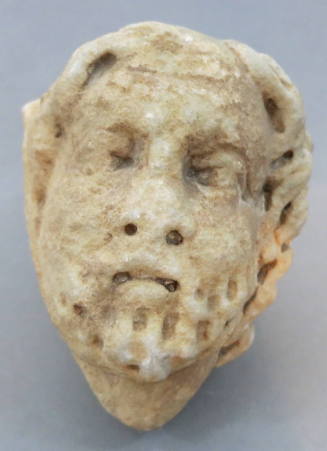
Classical (Ancient European: Italian)
2nd-3rd c
Culture: Italian
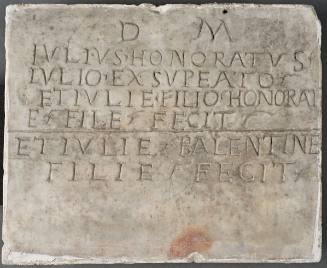
Classical (Ancient European: Roman)
2nd-3rd c
Culture: Roman
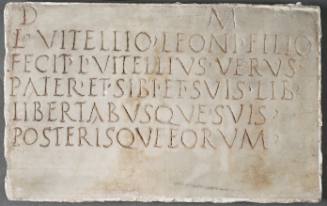
Classical (Ancient European: Roman)
1st-3rd c
Culture: Roman
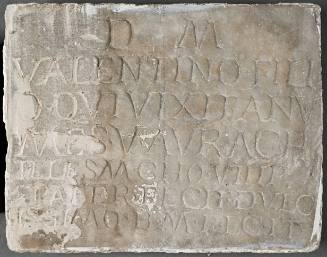
Classical (Ancient European: Roman)
3rd c
Culture: Roman
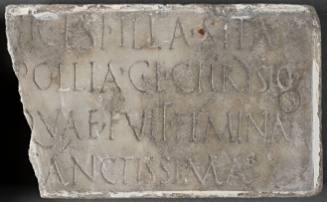
Classical (Ancient European: Roman)
1st c BCE- 1st c CE
Culture: Roman
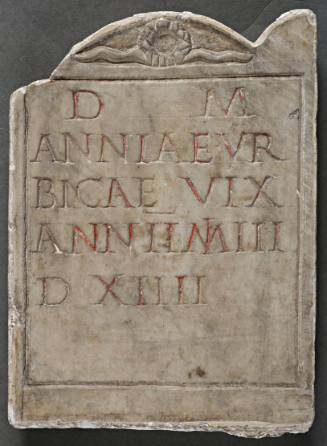
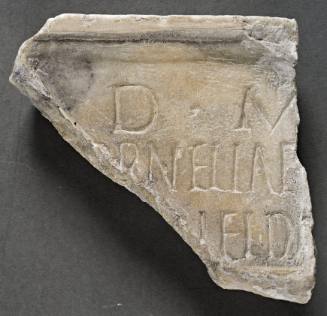
Classical (Ancient European: Roman)
1st - 3rd c
Culture: Roman
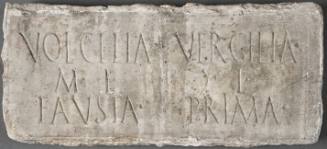
Classical (Ancient European: Roman)
1st - 2nd c
Culture: Roman
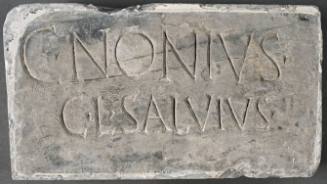
Classical (Ancient European: Roman)
1st - 3rd c
Culture: Roman
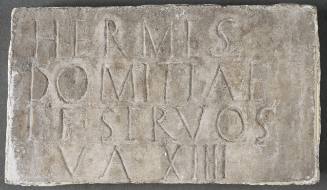
Classical (Ancient European: Roman)
1st c BC - 3rd c CE
Culture: Roman
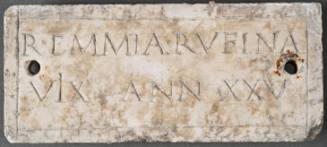
Classical (Ancient European: Roman)
1st c BCE - 3rd c CE
Culture: Roman
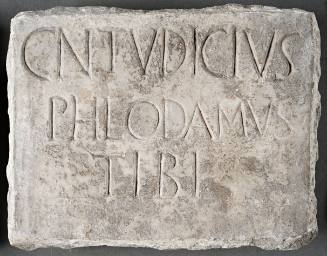
Classical (Ancient European: Roman)
1st - 3rd c
Culture: Roman