
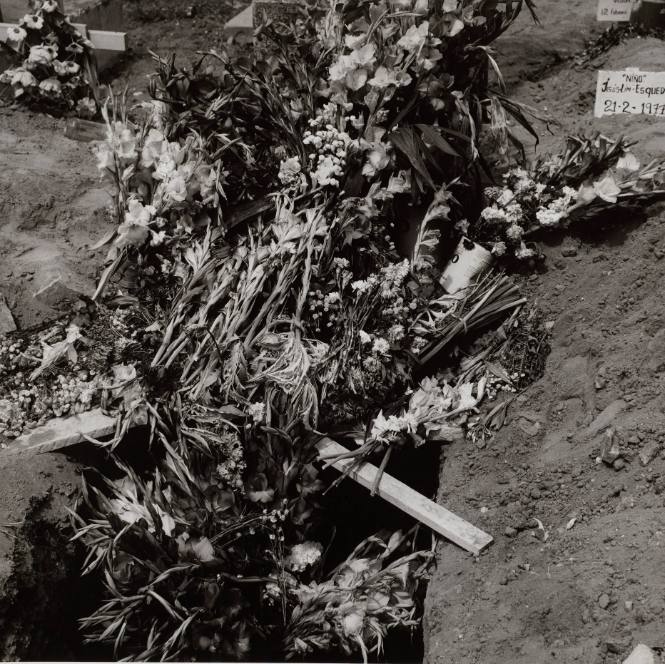
Object number2003.47.5
Flowers for the Dead II, Mazatlan, Mexico
Date1977
Artist
Peter Hujar
(American, 1934-1987)
CultureAmerican
MediumGelatin silver print, printed later?
DimensionsImage: 14 9/16 x 14 15/16 in. (37 x 38 cm)
Sheet: 20 1/16 x 16 1/8 in. (51 x 41 cm)
Matted: 28 x 22 in. (71.1 x 55.9 cm)
Sheet: 20 1/16 x 16 1/8 in. (51 x 41 cm)
Matted: 28 x 22 in. (71.1 x 55.9 cm)
Credit LineGift of Stephen Koch
Period20th c
Classification(s)
InscribedOn verso, by unidentified hand, lower center in pencil: Flowers for the Dead (II) / Mazatlan, Mexico; by Stephen Koch, Executor, lower right within estate # stamp in pencil: 756-4-7 / Stephen Koch / EPH804-2; by unidentified hand, lower center edge in pencil: FLLAC 2003.47.5
MarkingsOn verso, stamped lower right corner: FROM THE ESTATE #; stamped lower center: COPYRIGHT 19_ _ / THE ESTATE OF PETER HUJAR / NOT TO BE REPRODUCED IN ANY FORM / WITHOUT WRITTEN PERMISSION FROM / THE ESTATE; stamped lower left: THE ESTATE OF PETER HUJAR / STEPHEN KOCH EXECUTOR / PRINTED BY THE ARTIST
BibliographyKwinter, Taia. Peter Hujar: Speed of Life. New York: Aperture, 2017, p. 84, pl. 31 ;
EPH 804-2 (Estate of Peter Hujar)ProvenanceGift of Stephen KochVassar Exhibitions
Exhibition HistoryPeter Hujar: Speed of Life, MAPFRE, Barcelona, Spain, January 26 - May 20, 2017Label Text“Peter Hujar knows that portraits in life are always, also, portraits in death,” wrote Susan Sontag in her introduction to the only photography book that Hujar published during his lifetime. The following year, Hujar made this photograph during Día de los Muertos on a trip to the coastal city of Mazatlan, Mexico. Hujar was known for making stripped down, black and white portraits of fellow artists and writers in New York City. Though this photograph is a still life of flowers lying on a gravesite, it seems to stand in for a person—a picture honoring life after the fact. Like many American photographers in the twentieth century, Hujar was disillusioned by what he saw as a hollowness of American culture, and looked to Mexico as a place deeply rooted in spiritual traditions, including those paying respect to the dead. Years before Hujar’s community was besieged by the HIV/AIDS epidemic, which took his own life in 1987, he was interested in photographs as memento mori, or visual reminders of the constant presence of death in life.
DescriptionVarieties of flowers, bundled and loose, placed atop an open dirt grave and markers visible in the background on rightTerms
Object information is a work in progress and may be updated as new research findings emerge.
To help improve this record, please email
loebcollections@vassar.edu


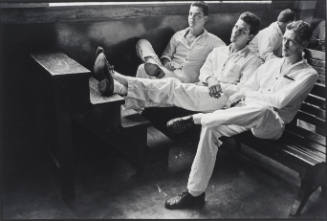
Danny Lyon
1968/1969
Culture: American