Object number1987.53.89
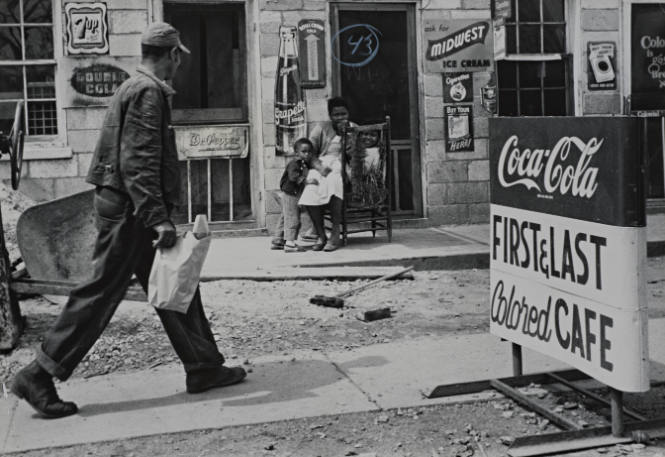
First & Last, Mississippi
Date1953
Artist
Rosalie Thorne McKenna
(American, 1918-2003)
CultureAmerican
MediumGelatin silver print
DimensionsImage: 9 3/16 x 13 5/16 in. (23.4 x 33.8 cm)
Matted: 16 x 22 in. (40.6 x 55.9 cm)
Matted: 16 x 22 in. (40.6 x 55.9 cm)
Credit LineGift of the artist
On View
Not on viewPeriod20th c
Classification(s)
InscribedOn verso, by artist, center in pencil: Miss. 4[circled] # 33; by unidentified hand, upper left corner in red ink: II-5; right center edge in red ink: TBN; lower right corner in pencil: 87.53.89
MarkingsOn verso, stamped upper center: Photo By: / ROLLIE MCKENNA / ONE HANCOX STREET / STONINGTON, CONN. / AREA CODE 203 533-0110 / Not To Be Reproduced / Without Permission / Please Credit With Photo; partially visible stamp center [vertical]: PHOTO [...] / ROLLIE MC[...]NA / 438 EAS[...]EET / NEW Y[...] Y. / TEL. EN[...]9 / Not To Be R[...]ed / Without Permission. / Please Credit With Photo; stamped lower right [address and telephone scribbled out]: PHOTO BY: / ROLLIE MCKENNA / 438 EAST 88 STREET / NEW YORK 28, N. Y. / TEL. ENRIGHT 9-3889 / Not To Be Reproduced / Without Permission. / Please Credit With Photo; ASMP MEMBER / AMERICAN SOCIETY OF MAGAZINE PHOTOGRAPHERS
On typed label, on verso upper right: FIRST & LAST [handwritten ? in pencil] / MISSISSIPPI, 1953
BibliographyRosalie Thorne McKenna, Rollie McKenna: A Life in Photography (New York: Knopf, 1991), 20. ProvenanceGift of the artistVassar Exhibitions
Label TextMcKenna wrote in her autobiography that “the South is firmly in my soul. Although my parents were not Southerners, I was born and reared there.” In 1953 she returned to the region visiting Mississippi with her good friend John Malcolm Brinnin on an assignment for Mademoiselle magazine. During this visit, she found the South timeless and unchanged from her childhood years. This continuity extended further in her discovery that her southern subjects were strikingly
similar to those of her great-grandmother Harriet van Schoonhoven Thorne. McKenna wrote that in the late 1800s, her great-grandmother “was photographing everyone, black or white,” which “revealed a two-way trust unusual in the circumstances” of the time. McKenna had a similar trust with her subjects in hopes of showing everyday dignity and respect in the midst of poverty.
DescriptionBlack man smiles as he walks by three Black children in front of storefront with large sign that reads: Coca-Cola, FIRST & LAST Colored CAFETerms
Object information is a work in progress and may be updated as new research findings emerge.
To help improve this record, please email
loebcollections@vassar.edu
Rosalie Thorne McKenna
c. 1959
Culture: American