
Tim Youd: Hudson Valley Retyped
Thursday, August 30, 2018 - Sunday, October 14, 2018
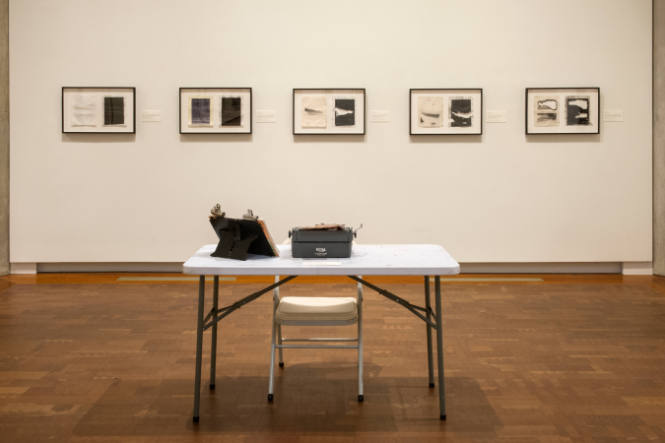
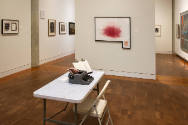
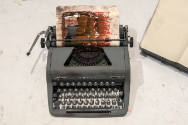
Tim Youd's "100 Novels" project is an ongoing performance art piece in which he retypes novels from beginning to end in locations that play a central role in the novels or the author's biography. Employing the same make and model typewriter used by the author, Youd types each novel on a single sheet of paper, which is backed by an additional support sheet. The artist loads the two-ply paper through the typewriter repeatedly until the entire novel has been retyped. As the typing progresses, the top sheet becomes saturated with ink and perforated from overuse, while the sheet underneath becomes embossed from indentation. Upon completion, the two pages are separated and mounted side by side as a framed diptych, recalling two pages of an open book with the words obscured. The diptych remains as a relic of the performance that embodies the novel, even though it is completely illegible.
During the spring of 2018 at Vassar, Youd retyped "The Group," a fictional account of the post-graduation life of eight Vassar women by distinguished novelist, essayist, and critic Mary McCarthy. McCarthy, who graduated from Vassar in 1933, purportedly based her characters on her group of college friends. After retyping "The Group," Youd spent most of June and July in the Hudson Valley retyping novels that related to the region. For the last of these performances, Youd returned to Vassar to retype "The Complete Poems: 1927-1979" by Elizabeth Bishop, Vassar class of 1934. With poetry and screenplays Youd deviates somewhat from his own strict rules for retyping novels; he symbolizes these transgressions by using red ink for poems and pressure-sensitive film instead of paper for screenplays. In these works color functions not only as a formal element but as a way to code these categories as separate from but related to the novels.
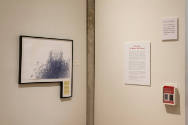
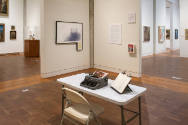
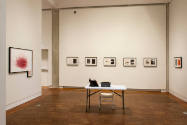
On view were all seven diptychs that were retyped during the summer of 2018 in the Hudson Valley, as well as two large-scale "tally drawings" composed of numerous superimposed sketches of the typewriters used by McCarthy and Bishop. Framed below the graphite drawings was a stack of index cards on which Youd typed a tally of the number of times and the dates that he redrew the typewriter up to 100.
Youd's work blurs the boundaries of performance and visual art and, in doing so, encourages the viewer to bear witness to the act of creation, calling attention to the tedious and sometimes grueling aspects of art making, whether producing a work of fiction of an art object to be encountered visually.
This exhibition was funded in part by the Helen Forster Novy 1928 Fund. There are works that appeared in this exhibition that were loans to the Loeb and therefore do not appear on this website.
During the spring of 2018 at Vassar, Youd retyped "The Group," a fictional account of the post-graduation life of eight Vassar women by distinguished novelist, essayist, and critic Mary McCarthy. McCarthy, who graduated from Vassar in 1933, purportedly based her characters on her group of college friends. After retyping "The Group," Youd spent most of June and July in the Hudson Valley retyping novels that related to the region. For the last of these performances, Youd returned to Vassar to retype "The Complete Poems: 1927-1979" by Elizabeth Bishop, Vassar class of 1934. With poetry and screenplays Youd deviates somewhat from his own strict rules for retyping novels; he symbolizes these transgressions by using red ink for poems and pressure-sensitive film instead of paper for screenplays. In these works color functions not only as a formal element but as a way to code these categories as separate from but related to the novels.
On view were all seven diptychs that were retyped during the summer of 2018 in the Hudson Valley, as well as two large-scale "tally drawings" composed of numerous superimposed sketches of the typewriters used by McCarthy and Bishop. Framed below the graphite drawings was a stack of index cards on which Youd typed a tally of the number of times and the dates that he redrew the typewriter up to 100.
Youd's work blurs the boundaries of performance and visual art and, in doing so, encourages the viewer to bear witness to the act of creation, calling attention to the tedious and sometimes grueling aspects of art making, whether producing a work of fiction of an art object to be encountered visually.
This exhibition was funded in part by the Helen Forster Novy 1928 Fund. There are works that appeared in this exhibition that were loans to the Loeb and therefore do not appear on this website.
Venues
Focus Gallery