Vito Acconci: Scenes from This Side of the Camp
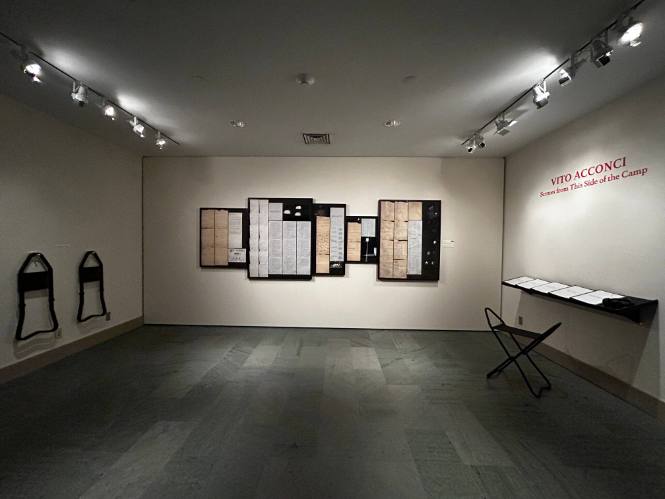
In November 1973, American conceptual artist Vito Acconci staged a live performance at Galleria Contemporanea in Rome. In the original presentation, Acconci attempted to recreate the atmosphere of a guerrilla war camp set up by revolutionaries as a place to gather. The archival installation, Scenes from This Side of the Camp, documents that performance through multiple elements that blur the lines between live performance, language, and audience perception. While not a direct commentary on the Vietnam War, the tension around America’s role in the conflict provides a backdrop for Acconci’s work from this period.
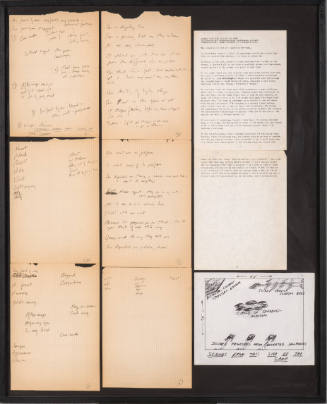
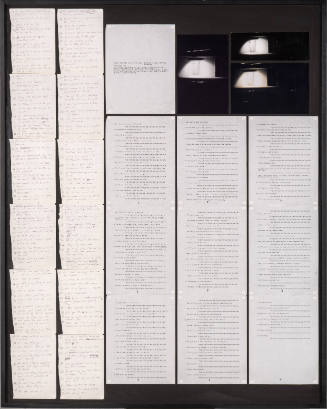
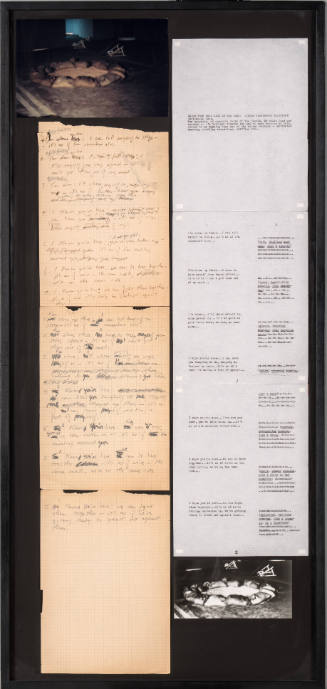
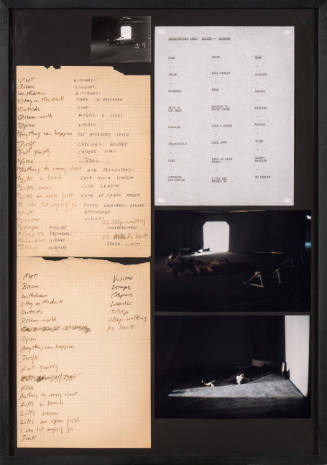
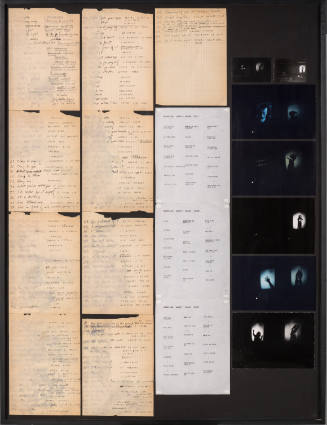
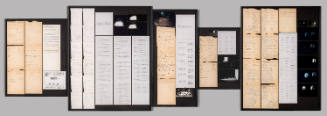
On view were Acconci's handwritten notes in English and Italian, enigmatic photographs offering glimpses into his creative process, and hand-typed pages that both guide the audience through the installation and analyze it as commentary on performance and weaponry. Words and phrases from these notes are spoken aloud by the artist on an accompanying audio track, creating a complex linguistic system for viewers to interpret. Together, these elements reveal Acconci's process of transforming words and actions into both commentary and confrontation, pushing the boundary between personal and shared experience. Because a live audience was integral to Acconci's work, the original performance cannot be fully recreated. However, each archival component serves as a clue to how the work was first intended to be experienced. In the artist’s words, installations such as this one leave behind a “vestige of [the] self.”
During the late 1960s and early 1970s, Acconci—a recognized poet in the esoteric literary world—often employed spoken word and his own body in performance spaces to challenge viewers' comfort and expectations. This was one of the last pieces he performed before removing himself physically and visually from his work, opting instead for a haunting and provocative auditory presence that focused attention on the spatial characteristics of the installation site. This shift reveals themes central to his practice throughout the 1970s, particularly the invisible tension that can exist between audience and maker.
This presentation was generously supported by the Hoene Hoy Photography Fund.