
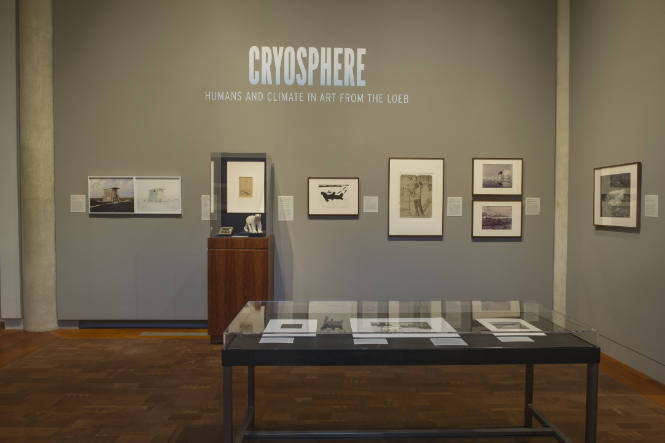
Cryosphere: Humans and Climate in Art from the Loeb
Tuesday, January 18, 2022 - Sunday, May 22, 2022
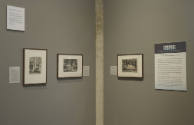
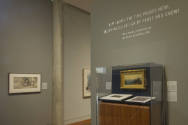
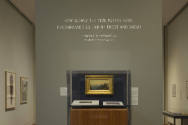
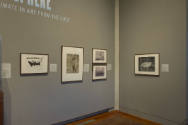
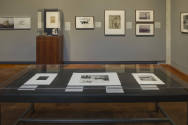
In 1886, literary naturalist and Hudson Valley resident John Burroughs wrote, “[I]n the snow-storm: we are admitted into Nature’s oldest laboratory.” This laboratory is part of the cryosphere, the term given to places on Earth where water is in solid, rather than liquid, form. Describing its fleeting and varied forms—ice and snow in particular—is a challenge shared by artists and scientists alike. On view in this exhibition were works of art, from the 1800s to today, that show the cryosphere in Asia, Europe, North and South America, and Antarctica.
Works of art can not only convey the beauty and peril of the cryosphere, but also enhance our comprehension of the concept. In this exhibition, depictions of ice and snow—rendered in paintings, prints, drawings, and photography—are approached using the methods and knowledge of an earth scientist. Considered are the characteristics and nature of the cryosphere, the North and South Poles, and fluctuations in the Earth’s temperature as they impact the amount of ice on the planet, particularly during the rapid warming that has occurred in recent years. As scientists can attest, the vast temporal and spatial scale of Earth’s processes often cannot be captured fully with verbal descriptions. Images can help us to perceive them.
Study of the cryosphere goes hand in hand with study of human beings’ influence on climate. Reconciling long-held perceptions (and memories) of ice, snow, and winter as seen in these works of art with the current realities of our planet is not an easy task. Rather, what such an exercise makes clear is that neither the visual language of art nor science can confront the complexity of the climate crisis alone. Instead, thinking must expand beyond discreet disciplines as humanity employs every possible means—scientific, artistic, and beyond—to address our geological moment in time.
This exhibition was co-organized by the Frances Lehman Loeb Art Center and Jill Schneiderman, Professor of Earth Science. This project and associated programming were supported by the Mellon Foundation and the Jill Troy Werner ’71 Endowment for Research and Teaching on Climate Change and Sustainability. There are works that appeared in this exhibition that were loans to the Loeb and therefore do not appear on this website.
Works of art can not only convey the beauty and peril of the cryosphere, but also enhance our comprehension of the concept. In this exhibition, depictions of ice and snow—rendered in paintings, prints, drawings, and photography—are approached using the methods and knowledge of an earth scientist. Considered are the characteristics and nature of the cryosphere, the North and South Poles, and fluctuations in the Earth’s temperature as they impact the amount of ice on the planet, particularly during the rapid warming that has occurred in recent years. As scientists can attest, the vast temporal and spatial scale of Earth’s processes often cannot be captured fully with verbal descriptions. Images can help us to perceive them.
Study of the cryosphere goes hand in hand with study of human beings’ influence on climate. Reconciling long-held perceptions (and memories) of ice, snow, and winter as seen in these works of art with the current realities of our planet is not an easy task. Rather, what such an exercise makes clear is that neither the visual language of art nor science can confront the complexity of the climate crisis alone. Instead, thinking must expand beyond discreet disciplines as humanity employs every possible means—scientific, artistic, and beyond—to address our geological moment in time.
This exhibition was co-organized by the Frances Lehman Loeb Art Center and Jill Schneiderman, Professor of Earth Science. This project and associated programming were supported by the Mellon Foundation and the Jill Troy Werner ’71 Endowment for Research and Teaching on Climate Change and Sustainability. There are works that appeared in this exhibition that were loans to the Loeb and therefore do not appear on this website.
Venues
Focus Gallery