
The Great Wonder: Violet Oakley and the Great Gothic Revival at Vassar
Saturday, February 27, 2021 - Sunday, June 13, 2021
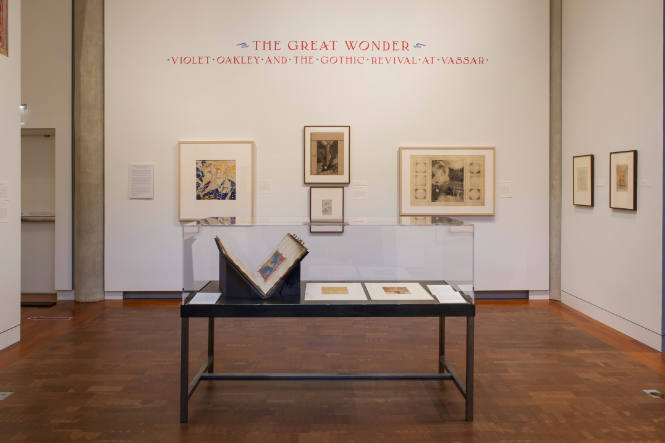
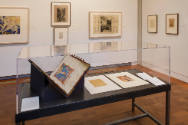
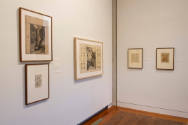
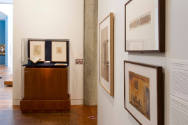
For the opening of Vassar’s Alumnae House in 1924, Violet Oakely (1874–1961) created the large-scale triptych, The Great Wonder: A Vision of the Apocalypse. Oakley was an American artist best known for her murals and stained glass evocative of the Italian Renaissance. She created the triptych as a memorial to her sister, Hester Caldwell Oakley Ward, a member of Vassar’s class of 1891 who died of typhoid fever in 1905. This exhibition focused on the numerous preparatory works on paper related to the project now in the collection of the Frances Lehman Loeb Art Center.
The format of The Great Wonder echoes Italo-Byzantine altarpieces, with a central devotional image flanked by related narrative scenes. The imagery comes from St. John’s Book of Revelation, and is dominated at center by a monumental woman hovering against a star-filled sky. The artist expressed her intention for the work in these words: “The Great Wonder. . . May it serve to lift up Every-Woman who contemplates it.” Oakley designed the surrounding room to enhance the triptych’s impact. Elements included patterned beams and shutters (painted by her students Edith Emerson and Carolyn Haywood), and antique furnishings including an Italian refectory table, Savonarola chairs, choir stalls, and candelabras, only some of which remain today. For this project, Oakley also conceived an elaborate pageant for the dedication and an accompanying medieval-style manuscript.
Through this exhibition, viewers can begin to envision this endeavor as it was originally conceived by the artist. Emerging from these preparatory works is Oakley’s creative process as she worked through issues of composition, palette, and design, all in the service of creating an immersive experience through art.
Organizers of the exhibition included the Loeb’s Curator of Academic Programs, Elizabeth Nogrady; Christopher Platts (visiting professor, Department of Art); and the students of ART 218: The Museum in History, Theory, and Practice. This exhibition was supported by the Mellon Foundation.
The format of The Great Wonder echoes Italo-Byzantine altarpieces, with a central devotional image flanked by related narrative scenes. The imagery comes from St. John’s Book of Revelation, and is dominated at center by a monumental woman hovering against a star-filled sky. The artist expressed her intention for the work in these words: “The Great Wonder. . . May it serve to lift up Every-Woman who contemplates it.” Oakley designed the surrounding room to enhance the triptych’s impact. Elements included patterned beams and shutters (painted by her students Edith Emerson and Carolyn Haywood), and antique furnishings including an Italian refectory table, Savonarola chairs, choir stalls, and candelabras, only some of which remain today. For this project, Oakley also conceived an elaborate pageant for the dedication and an accompanying medieval-style manuscript.
Through this exhibition, viewers can begin to envision this endeavor as it was originally conceived by the artist. Emerging from these preparatory works is Oakley’s creative process as she worked through issues of composition, palette, and design, all in the service of creating an immersive experience through art.
Organizers of the exhibition included the Loeb’s Curator of Academic Programs, Elizabeth Nogrady; Christopher Platts (visiting professor, Department of Art); and the students of ART 218: The Museum in History, Theory, and Practice. This exhibition was supported by the Mellon Foundation.
Venues
Focus Gallery