The Silver in the Attic: Historical Archeology at Vassar College
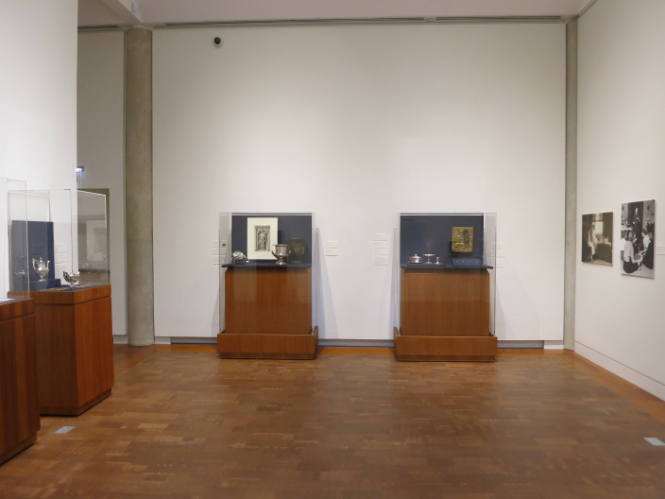
The silver bows, cutlery, and coffee sets on view in this exhibition were found in the attic of a Vassar building constructed in 1896. Their provenance is largely unknown, a mystery which motivated their study: how did this collection come to be? To answer this question, and learn more about the life story of each object's use and discard, they were examined using the techniques of historical archaeology.
The anthropological, rather than art historical, approach of this exhibition was not a typical one for the Art Center. To highlight this departure, the silver - primarily hollowware related to table service - is presented not as fine art, but as artifacts. The objects chosen for investigation, most of which date from 1900 to 1950, bear identifying characteristics such as monograms and makers' marks. Use wear, breaks, and repairs show how they were utilized, with additional context provided by historic photographs and archival records. Grouping of diverse items, in some instances with works from the Art Center's collection, reveals how methods of historical archaeology can illuminate various characteristics of the pieces and be applied across time, space, and discipline.
As luxury artifacts, these silver objects are manifestations of past peoples' aspirations. Together, they tell us about the people who owns, used, and donated them to Vassar. While the decorative arts in this exhibition may not be exceptionally old or even rare, to an anthropologist, they are proxies for people whose lives brought their prized possessions to rest in a Vassar attic.
This exhibition was an interdisciplinary collaboration between the Frances Lehman Loeb Art Center, Kelly Bernatzky '19, Emma Wiley '20, and April M. Beisaw, Associate Professor of Anthropology.