
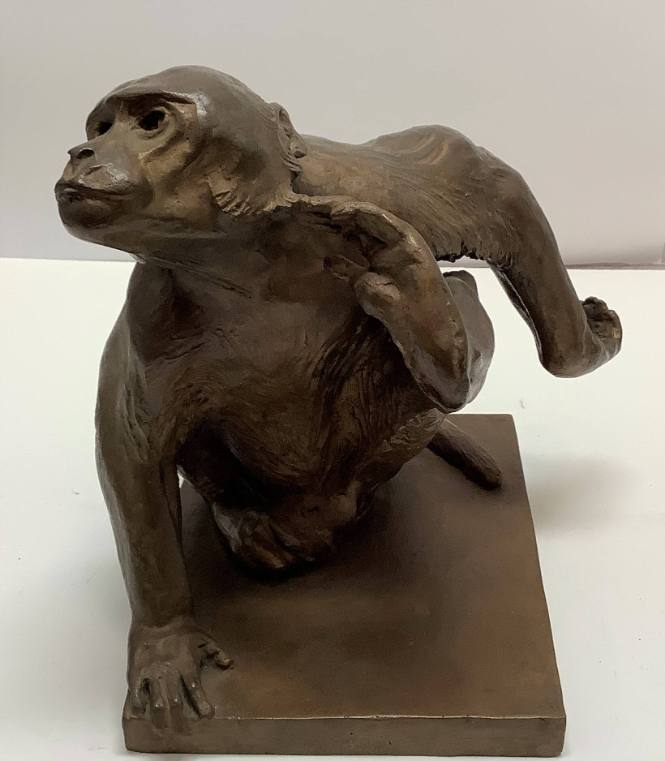
Bronze Small Scale
Sunday, April 1, 1990 - Tuesday, September 3, 1991
This exhibition of small bronze sculptures from the permanent collection traces the development of the bronze casting process. The twelve sculptures included here present a sampling of the range of expression bronze has to offer.
The production of small bronzes is linked with the development of the Cire perdu or lost-wax method of casting. This method was known to the Summerians, in the Indus Valley in the third millennium and, in Egypt and China circa 1500 B.C. The method that came into use among the Greeks and extensively employed thereafter, required the formation of a mold over an original model of wood, stone, clay, or plaster. The surface of the mold, after removal of the prototype was then covered with a layer of wax and filled with a core of refractory material. The wax could then be melted out as before, and the bronze poured in. This preserved the model for later use, and it enabled endless reproduction from the original work. The lost wax technique, continued to be the principal method employed for forming bronze work until the nineteenth century, when the process of electrotyping was devised.
The subject of style in bronze work is a direct function of its technique. A stone statue is imprisoned inside a block of stone, to be liberated by taking away the material with chisels. Metal statuary, is not usually formed by reductive means, but by an additive process. Most original models are made in a plastic substance such as clay or wax. Modeling in wax or clay represents the most direct expression of the sculptor and casting in bronze represents the most faithful replica of this expression in permanent form.
Patination results from the temporal corrosion of copper alloys to a point where the tin separates from the copper. Usually, the effects of corrosion are limited and do not penetrate much below the surface. Chemical patination is employed to impart color to the surface. The agents used ranged from sal ammoniac, known to the Romans, to smoking, with green willow twigs and old shoes as fuel.
—Ramon K. Woo '90
The production of small bronzes is linked with the development of the Cire perdu or lost-wax method of casting. This method was known to the Summerians, in the Indus Valley in the third millennium and, in Egypt and China circa 1500 B.C. The method that came into use among the Greeks and extensively employed thereafter, required the formation of a mold over an original model of wood, stone, clay, or plaster. The surface of the mold, after removal of the prototype was then covered with a layer of wax and filled with a core of refractory material. The wax could then be melted out as before, and the bronze poured in. This preserved the model for later use, and it enabled endless reproduction from the original work. The lost wax technique, continued to be the principal method employed for forming bronze work until the nineteenth century, when the process of electrotyping was devised.
The subject of style in bronze work is a direct function of its technique. A stone statue is imprisoned inside a block of stone, to be liberated by taking away the material with chisels. Metal statuary, is not usually formed by reductive means, but by an additive process. Most original models are made in a plastic substance such as clay or wax. Modeling in wax or clay represents the most direct expression of the sculptor and casting in bronze represents the most faithful replica of this expression in permanent form.
Patination results from the temporal corrosion of copper alloys to a point where the tin separates from the copper. Usually, the effects of corrosion are limited and do not penetrate much below the surface. Chemical patination is employed to impart color to the surface. The agents used ranged from sal ammoniac, known to the Romans, to smoking, with green willow twigs and old shoes as fuel.
—Ramon K. Woo '90